Why Simple Trading Strategies Beat Complex Ones (And How to Stop Overcomplicating Your Trades)
A viral Reddit post reminded traders that complexity is the enemy of consistency. Simple strategies with fewer variables outperform complex ones.

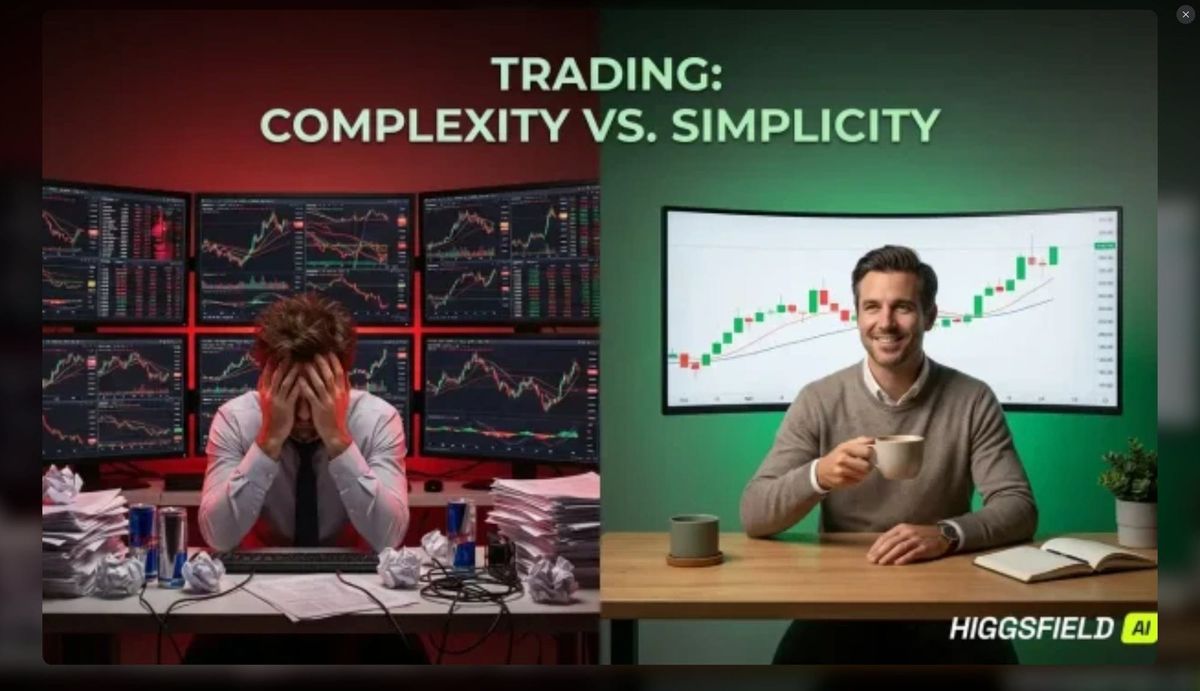
A viral Reddit post this week reminded traders of a truth most learn the hard way: complexity is the enemy of consistency.
The post, which racked up over 460 upvotes and nearly 200 comments on r/Daytrading, laid out a brutally simple approach to trading. No proprietary indicators. No elaborate multi-timeframe confluence. Just a handful of clear rules that anyone could follow.
"A cash account of 5k is all you need," the trader wrote. "Scalp profits as soon as you see it near the next resistance; there's no such thing as taking profits too early; you can't predict the future; let the small wins add up, rather than hoping for home-runs."
The response was overwhelming — not because the strategy was revolutionary, but because it violated everything traders are conditioned to believe about "edge."
The Complexity Trap That Kills Most Traders
Here's what nobody tells you when you start trading: the more indicators you add, the worse you'll perform.
Research from Quantified Strategies confirms what experienced traders already know — simple trading strategies with fewer variables tend to outperform complex ones over time. The reason isn't that simplicity is inherently better; it's that complexity creates more opportunities for human error, second-guessing, and emotional decision-making.
Think about your own trading for a moment. How many times have you:
- Added an indicator because you "needed more confirmation"
- Hesitated on a valid setup because one indicator disagreed
- Missed entries because you were waiting for perfect confluence
- Changed your strategy after a losing streak, adding more rules
Each addition feels like you're improving your system. In reality, you're building a Rube Goldberg machine that's increasingly difficult to execute consistently.
As one trader in the Reddit thread put it: "The more complex your system, the more ways it can fail. Simple systems have fewer failure points."
The "Small Wins" Philosophy That Actually Works
The viral post's most controversial claim? "There's no such thing as taking profits too early."
This runs counter to everything trading gurus teach. "Let your winners run!" they shout. "The home runs pay for the strikeouts!"
But here's the math most traders ignore:
If you're targeting 2-3% per day with consistent small wins, and you trade 200 days per year, even a modest success rate compounds into life-changing returns. Meanwhile, traders chasing home runs often give back their gains waiting for the "big one" that never comes — or comes right after they've already exited.
The Reddit trader's approach is refreshingly mechanical:
- Scan for top premarket movers with volume over 10M
- Scale into positions on pullbacks (buy into fear, not FOMO)
- Take profits near resistance — don't wait for perfection
- Repeat until daily capital is deployed
No predictions. No hoping. Just execution.
Why "Boring" Trading Is the Only Trading That Lasts
The comments on the Reddit post were split between two camps: traders who'd learned this lesson through years of painful experience, and traders convinced there must be "more to it."
There isn't.
One commenter shared their journey: "I spent 3 years adding indicators, testing complex systems, and blowing accounts. Then I stripped everything down to price action and volume. First profitable year."
Another wrote: "The hardest part isn't finding a strategy. It's trusting a simple one long enough to see it work."
This is the psychological trap of trading. Simple feels wrong. Our brains are wired to believe that complex problems require complex solutions. We equate effort with results, so we add more screens, more indicators, more rules — all of which make us feel like serious traders while actually degrading our performance.
The Indicators Addiction Cycle
Here's how it typically goes:
- Start simple — Learn a basic setup, have some early success
- First losing streak — Assume the strategy needs "improvement"
- Add indicators — RSI for overbought/oversold, MACD for momentum
- Temporary improvement — Feel smarter, attribute wins to new tools
- Bigger losing streak — More indicators clearly needed
- Analysis paralysis — Now need 5 things to align for any trade
- Abandon strategy — Start over with something "better"
- Repeat indefinitely
- The traders who break this cycle are the ones who commit to simplicity even when it feels uncomfortable. They understand that edge comes from consistent execution, not from having the most sophisticated setup in the room.
- Based on the Reddit discussion and the experiences of consistently profitable traders, here are the principles that actually matter:
- Every condition you add to a strategy is another opportunity to hesitate, second-guess, or misread. The best traders we've studied use 2-3 criteria maximum for entries.
- Ask yourself: Could you explain your entry criteria in one sentence? If not, you're probably overcomplicating it.
- The "home run" mentality destroys more accounts than bad entries. Small, consistent wins compound. Large, infrequent wins require perfect timing that nobody has.
- The math: 1% daily gains, compounded over 200 trading days, equals over 600% annual returns. You don't need home runs.
- Complex strategies work great in backtesting when you have unlimited time to analyze. In real-time, with real money on the line, your brain is running at half capacity. Your strategy needs to be simple enough to execute when your heart rate is elevated and adrenaline is flowing.
- Test this: Can you identify and execute your setup within 10 seconds? If you need longer, simplify.
- The hardest part of simple trading isn't the strategy — it's the psychology.
- When you're sitting on your hands because no setup appeared, you feel like you're "missing out." When you take a small win while the trade continues higher, you feel like you "left money on the table." When your simple setup loses three times in a row, you feel like you need to "improve" it.
- Every one of these feelings is wrong. And every one of these feelings is normal.
- The traders who maintain simplicity do so through structure, not willpower:
- Fixed daily trade limits — Physically can't overtrade
- Pre-defined exits — No decision-making required in the moment
- Daily routine that ends — Close charts, walk away, don't look back
- Written rules they review — Keeps them accountable to their system
- Here's the uncomfortable truth the Reddit post hinted at: the simplest possible trading is trading that doesn't require you at all.
- When a trader says "become emotionless and dead inside to walk away and not look back," they're describing the ideal state for consistent profitability. They're also describing something that goes against human nature.
- This is why automation has become so attractive to traders who've fought this battle. When rules are coded and executed automatically, there's no:
- Hesitation on valid setups
- Early exits due to fear
- Late exits due to greed
- Revenge trades after losses
- Position sizing errors under stress
- The system does exactly what you told it to do, every single time. It achieves the "boring, mechanical" ideal that the Reddit trader described — without requiring superhuman discipline.
- If you're currently running a complex system with multiple indicators and confluence requirements, consider this experiment:
- Strip it down to the core — What's the ONE thing that actually matters for your entries?
- Backtest the simple version — You might be surprised how little you lose (or how much you gain)
- Paper trade for two weeks — Feel the discomfort of simplicity
- Track your execution — Are you following your simple rules consistently?
- Most traders who do this discover something uncomfortable: their complex system was actually worse, but felt better because it gave them more to do.
- The market doesn't reward effort. It rewards correct execution. And correct execution is infinitely easier when there's less to execute.
- StealthScalp takes simplicity to its logical conclusion — fully automated execution that removes human emotion entirely. One trade per day. ICT-inspired logic. No second-guessing, no hesitation, no complexity.
- Learn How StealthScalp Automates the "Boring" Trading That Actually Works
- The viral Reddit post resonated because it told traders what they already knew but didn't want to accept: simple works, complex fails, and the hardest part is trusting simplicity long enough to see results.
- You don't need more indicators. You don't need more confluence. You don't need a more sophisticated system.
- You need a simple strategy you can execute consistently, day after day, without emotion getting in the way. Whether you achieve that through iron discipline or intelligent automation, the destination is the same: boring, profitable, repeatable trading.
- The traders in that Reddit thread who've made it? They all said the same thing: "I wish I'd learned this years ago."
- Don't wait years. Start simple today.
- Related Reading: