Why Boring Trading Is Profitable Trading: The One-Trade-Per-Day Approach

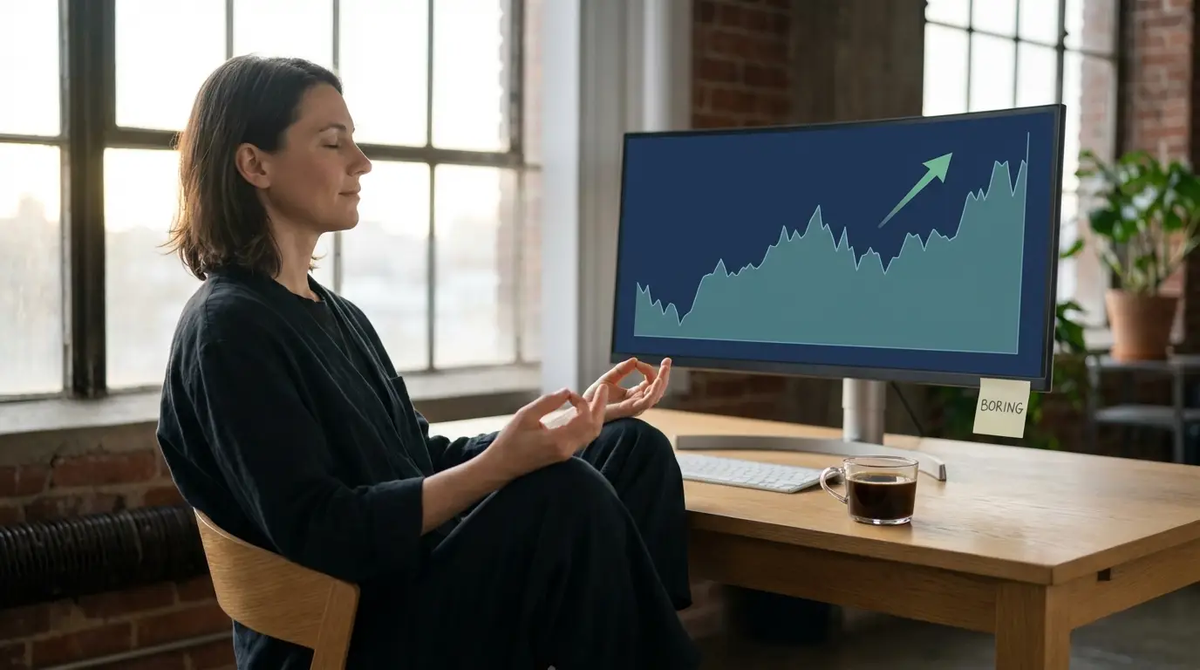
Why the Best Traders Are the Most Bored Traders
A trader just posted on r/Daytrading about hitting their first $10,000 month in January 2026 — and the secret wasn't some exotic indicator or complex multi-timeframe system. It was sticking to one strategy, taking one or two trades per session, and being completely okay with feeling bored.
"Most days feel pretty boring now (which is good). No high heart rate when in trades," the trader wrote, to a thread that quickly racked up over 1,100 upvotes and nearly 200 comments.
The trading community is having a collective realization: excitement is the enemy of profit.
If your trading feels like a slot machine, you're doing it wrong. If it feels like data entry, you might actually be on to something.
The Dopamine Trap: Why Most Traders Overtrade
Another post that went viral on r/Daytrading recently put it bluntly: "Your edge isn't missing. Your dopamine regulation is broken."
The poster had analyzed not just their P&L, but the timestamps of their losing trades. The pattern was clear — losses clustered in moments of impatience, during hours where nothing was really happening but they "needed" to be in a trade.
Sound familiar?
Here's the uncomfortable truth that keeps showing up in trading forums: most people aren't trading to make money. They're trading to feel something.
When you sit in front of charts for three hours and nothing happens, your brain starts screaming. It craves the dopamine hit of clicking "Buy." Entering a position validates your time. It makes you feel like you're working.
But trading is the only profession where doing nothing is a paid activity.
The Numbers Don't Lie: Overtrading Destroys Accounts
Studies consistently show that 90% or more of retail traders lose money. While there are many reasons for this — poor risk management, no edge, underfunding — overtrading is one of the biggest silent killers.
Every additional trade you take has a cost:
- Commission and fees — they add up faster than you think, especially on futures
- Slippage — more entries means more chances for fills away from your target price
- Emotional compounding — a loss on trade #3 makes you revenge trade on #4, which makes #5 a disaster
- Decision fatigue — your judgment gets worse with every decision, not better
One trader on r/FuturesTrading summed it up perfectly: "My best months are always the ones with the fewest trades. My worst months? Those are the ones where I was 'active.'"
What One Trade Per Day Actually Looks Like
The trader who posted that $10K month result described a process that sounds almost disappointingly simple:
- Wait for one specific setup — no hunting, no forcing, no "this kind of looks like it"
- Execute the plan — entry, stop loss, target. Click. Done.
- Walk away — or at most, manage the single position with predefined rules
That's it. No 47 indicators. No switching between six timeframes. No watching every tick like your life depends on it.
As one commenter noted: "Boring is profitable. Might be the simplest and most important lesson I've ever gained from day trading. Wanting to get into the action is wanting to get into debt."
The One-Trade Framework for Futures
If you trade futures — especially NQ, ES, or other index futures — here's what a one-trade-per-day framework might look like:
- Pre-market: Mark key levels (previous day high/low, overnight range, major support/resistance)
- Wait window: Only consider trades during your best-performing session (usually first 2 hours of NY open)
- Single setup: Have ONE pattern you look for — whether it's a fair value gap fill, an opening range breakout, or a specific order flow signal
- Fixed risk: Same position size, same stop distance, same R:R ratio every single day
- Done by noon: Win or lose, you're finished. No "let me get it back" trades
This approach isn't just about discipline — it's about math. If your one setup has a 55-60% win rate with a 1:2 risk-to-reward ratio, you don't need more trades. You need consistency.
Why This Matters Even More for Prop Firm Traders
If you're trading a prop firm evaluation — Apex, TopStep, MyFundedFutures, or any other — the one-trade-per-day approach isn't just smart. It might be your best strategy for passing.
Here's why:
Consistency Rules Love Boring Traders
Most prop firms now have some form of consistency rule. They don't want to see one monster day carrying your entire evaluation — they want steady, repeatable results. Taking one solid trade per day naturally produces the kind of equity curve prop firms want to see.
Drawdown Protection Is Built In
The fastest way to hit a trailing drawdown limit? Take five mediocre trades on a bad day instead of one planned loss. With a single-trade approach, your worst day is limited to your predetermined stop loss — not an emotional spiral.
You Actually Finish Evaluations Faster
It sounds counterintuitive, but traders who take fewer, higher-quality trades often pass evaluations faster than hyperactive traders. Why? Because they don't have blowup days that set them back a week.
As one prop firm trader on Reddit explained: "I failed 6 evaluations taking 10+ trades a day. Passed my 7th taking 1-2 trades. Same strategy, just stopped overtrading."
The Automation Advantage: Removing Yourself From the Equation
Here's the part most traders don't want to hear: even if you know one trade per day is optimal, your brain will fight you every step of the way.
That dopamine system we talked about? It doesn't care about your P&L. It doesn't care about your drawdown limits. It wants stimulation, and it will convince you that "this one extra trade is different."
This is exactly why automated trading strategies have been gaining traction in the futures community. When you remove the human element from execution, you remove:
- Revenge trading — the bot doesn't feel anger after a loss
- FOMO entries — it doesn't panic when it "missed" a move
- Overtrading — if it's programmed for one trade, it takes one trade
- Late-session desperation — no "just one more" at 3:45 PM
→ This is exactly what StealthScalp was built for. It's a fully automated NinjaTrader 8 strategy that takes one trade per day on futures, then shuts off. No emotion, no overtrading, no second-guessing. It executes the same way whether you're watching or at the gym. Learn more about how automation can fix your overtrading problem →
How to Make Your Trading More Boring (in a Good Way)
Whether you trade manually or use automation, here are practical steps to embrace boring, profitable trading:
1. Set a Hard Trade Limit
Before the session starts, decide: "I'm taking a maximum of [1-2] trades today." Write it on a sticky note. Put it on your monitor. When you hit the limit, close your platform.
2. Define "No Trade" Days
Not every day has a setup. Professional traders know that the best trade is sometimes no trade. If your setup doesn't appear by your cutoff time, you're done. Full stop.
3. Track Trades Per Day vs. Profit
Go through your last 3 months of data. Chart your daily P&L against the number of trades you took that day. We're willing to bet that your best days had the fewest trades, and your worst days had the most.
4. Create a Post-Trade Ritual
After your one trade, do something else. Go for a walk. Hit the gym. Work on another project. The goal is to break the association between "trading time" and "screen time." Your job is to wait for setups, not to stare at candles.
5. Use End-of-Day Flatten Rules
If you're trading futures, set a hard rule to flatten all positions before a specific time. This prevents the "let me just hold this overnight" temptation that has blown more accounts than bad entries ever have.
The Weekend Test
Here's a simple way to know if you're on the right track: How do you feel about the weekend?
If you dread it because you "can't trade," that's a red flag. It means your relationship with the markets is emotional, not professional.
If you enjoy the break and use it to review your journal, plan the next week, and live your life — that's a green flag. You're treating trading like a business, not a casino.
As the trader who posted that $10K month put it: "I feel comfortable taking losses, it all feels very routine."
Routine. Boring. Profitable.
That's the goal.
The Bottom Line
The Reddit trading community is figuring out what professional traders have known for years: less is more. One good trade beats ten mediocre ones. Boredom is not the enemy — it's the evidence that you're doing something right.
Whether you achieve this through raw discipline, strict rules, or by letting an automated strategy like StealthScalp handle the execution for you, the principle is the same: stop overtrading, start profiting.
→ Ready to stop overtrading? StealthScalp automates your futures trading with one disciplined trade per day — no emotion, no overtrading, no blown evaluations. Try it with a 30-day money-back guarantee →