Why Your Trading Plan Falls Apart in Live Markets (And How to Fix It)

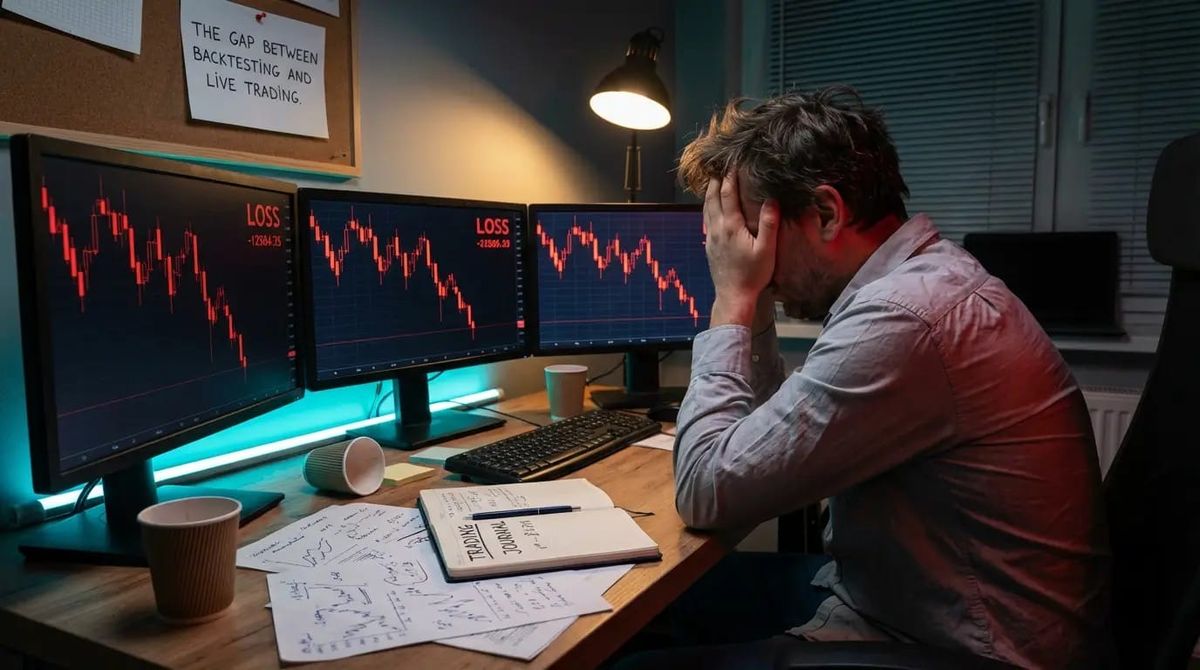
Every trader has been there. You spend weeks backtesting a strategy, crunching the numbers, building the perfect spreadsheet. Your win rate looks solid. Your risk-to-reward ratio is dialed in. On paper, you should be printing money by March.
Then Monday morning hits. And that beautiful trading plan turns into science fiction.
As one veteran trader on r/Daytrading put it after 15 years in the game: "As soon as Monday morning hits, that Excel sheet becomes a piece of science fiction."
He's not wrong. And if you've ever watched a perfectly backtested strategy crumble the moment real money is on the line, you already know exactly what he's talking about.
So what's actually going on? And more importantly — how do you fix it?
The Execution Gap: Why Backtests Lie
Here's a stat that should make every algo trader uncomfortable: roughly 9 out of 10 backtests produce wrong or misleading results, according to research from The Financial Hacker. That's not a rounding error — that's a systemic problem.
But the backtest itself isn't the real issue. The math can be perfectly valid. The problem is the human sitting in front of the screen trying to execute it.
Backtests assume perfect execution:
- You always enter at the exact price
- You never hesitate on a signal
- You never move your stop loss
- You never skip a trade because "it doesn't feel right"
- You never revenge trade after a loss
In reality? 72% of day traders end the year with financial losses, according to FINRA data. Not because they don't have strategies — but because they can't execute them consistently.
Your Nervous System Is the Real Enemy
This is the part most trading educators skip over. They'll sell you a course on chart patterns, ICT concepts, or order flow. But they won't tell you that your biology is actively working against you every time you place a trade.
Here's what actually happens when you go live:
The Dopamine Trap
Your brain releases dopamine not when you make money, but when you anticipate making money. That means:
- Scanning charts feels productive (even when there's nothing to trade)
- Clicking the buy button gives you a hit (even when the setup isn't there)
- Sitting on your hands feels like failure (even when it's the right move)
As that same r/Daytrading poster explained: "When you force yourself to find those '2 trades a day' to satisfy your spreadsheet, you aren't trading a strategy anymore. You are feeding a dopamine-seeking spiral."
The Fight-or-Flight Response
When you're in a losing trade, your amygdala — the brain's threat detection center — triggers a fight-or-flight response. Your prefrontal cortex (the rational part) gets overridden. This is why traders:
- Move stop losses further away ("just give it room")
- Exit winners too early (the relief of locking in profit overpowers the logic of letting it run)
- Revenge trade after a loss (fight response — you need to "get it back")
- Freeze and do nothing when a signal fires (flight response)
None of this shows up in a backtest. Your spreadsheet doesn't have a column for "panicked and closed early."
The Consistency Killer
Multiple threads on r/Daytrading and r/FuturesTrading echo the same theme: traders who have profitable strategies on paper but can't execute them consistently in live markets. One trader with 5 years of experience shared his top tip: "I eventually chose to solve this from another angle: automation of execution. It shifted my role from being inside the market emotionally to operating a trading process."
That's the key insight. The strategy isn't the problem. You are the problem.
The "Boring Administrator" Framework
The 15-year veteran who sparked this whole discussion introduced a concept he calls the "Pre-Click Protocol" — a framework designed not just for technical entries, but as a filter for his nervous system.
His core principle: professional trading is about being a boring administrator of risk.
Not a visionary. Not a genius chart reader. An administrator. Someone who:
- Follows the rules mechanically
- Doesn't care about missed moves
- Finds peace in doing nothing when conditions aren't met
- Measures success by process adherence, not P&L
He calls the ideal state "Contented Inactivity" — the ability to watch the market all day, take zero trades, and consider it a successful day.
Here's the problem: most humans are terrible at this.
We're wired to seek action, to feel productive, to respond to stimuli. Asking a human to sit in front of flashing charts for 8 hours and do absolutely nothing goes against every instinct we have.
Which is exactly why the traders who figure this out usually end up in the same place: automation.
Why Automation Bridges the Execution Gap
When you automate your trading strategy, you're not just saving time. You're solving the fundamental problem that causes most traders to fail: the gap between knowing what to do and actually doing it.
An automated strategy:
- Executes every valid signal — no hesitation, no second-guessing
- Respects every stop loss — no moving it "just this once"
- Takes one trade per day (or whatever your rules dictate) — no overtrading
- Doesn't revenge trade — the bot doesn't have emotions to manage
- Runs 24/7 — no missing setups because you slept in or had a meeting
As one commenter on r/Daytrading summarized: "The beauty of a mechanical strategy is to eliminate what we call psychology, emotions, discipline."
You don't need discipline when the machine handles execution. You don't need to manage emotions when you're not the one clicking the button. The entire "trading psychology" problem — which is really a human biology problem — disappears.
What About Slippage and Technical Issues?
Fair question. Automated systems do face real-world challenges:
- Slippage: Your fill price may differ from the backtested price. For liquid futures like ES and NQ, this is usually minimal (1-2 ticks).
- Connectivity: If your internet drops mid-trade, you could miss an exit. Running your bot on a VPS solves this.
- Market regime changes: A strategy that works in trending markets may struggle in chop. Good automated strategies account for this with filters.
These are solvable engineering problems. Trading psychology? That's a lifelong battle most traders never win.
How to Make the Shift from Manual to Automated
If you're convinced that automation is the answer (and the Reddit trading community increasingly is), here's the practical path:
Step 1: Define Your Rules With Zero Ambiguity
If you can't write your strategy as a set of IF/THEN rules, it's not ready for automation. Your rules need to be 100% mechanical:
- Entry: What exact conditions trigger a trade?
- Exit: What's your target and stop loss — in ticks, not feelings?
- Filters: What market conditions should prevent trading entirely?
- Position sizing: How many contracts, every time?
Step 2: Choose Your Platform
For futures traders, NinjaTrader 8 is the gold standard for automated strategy execution. It supports:
- Full strategy automation with NinjaScript
- Multiple broker connections (Tradovate, Rithmic, CQG)
- Real-time backtesting and optimization
- Strategy execution on VPS for 24/7 reliability
Step 3: Backtest Rigorously (But Realistically)
Use realistic slippage assumptions, account for commissions, and test across multiple market conditions. Walk-forward analysis beats simple backtesting.
Step 4: Run It on SIM First
Paper trade your automated strategy for at least 2-4 weeks. Compare SIM results to backtest results. If they diverge significantly, something needs fixing.
Step 5: Go Live — And Let It Run
This is the hardest part. Your nervous system will scream at you to intervene. Don't. The whole point is removing yourself from the equation.
One Trade Per Day: The Sweet Spot
One of the most discussed concepts across r/Daytrading, r/FuturesTrading, and r/prop_firms is the idea of limiting yourself to one trade per day.
The logic is simple:
- One good trade beats five mediocre ones — quality over quantity
- Fewer trades = fewer opportunities for emotional mistakes
- Prop firm consistency rules reward steady, predictable trading — not boom-and-bust days
- Your win rate matters less when your R:R is solid — one trade at 2:1 R:R with a 55% win rate is more profitable than ten trades with no edge
Automated strategies that take one trade per day are particularly effective for prop firm evaluations, where consistency is the name of the game.
→ StealthScalp by Trinity Trading automates this entire approach — one trade per day, fully automated on NinjaTrader 8, designed specifically for prop firm evaluations. No screen time, no emotional interference, no overtrading. Just a boring, consistent process that lets the math work.
The Market Doesn't Care About Your Feelings
This might be the most important thing the Reddit trading community keeps rediscovering: the market doesn't owe you a daily salary.
It doesn't care that you need to make $400 today. It doesn't care about your spreadsheet projections. It doesn't care that you've been staring at charts for six hours and haven't placed a trade.
The traders who survive long-term — the ones you see posting consistently profitable months on Reddit — all share the same trait: they've found a way to separate their emotions from their execution.
For some, that means years of meditation and journaling. For others, it means building strict pre-click protocols and training their nervous system through thousands of trades.
And for a growing number of traders, it means the simplest solution of all: let the machine do the trading.
Your brain was built for survival, not for scalping NQ. Stop fighting biology. Start working with it.
→ Ready to remove emotions from your trading? StealthScalp is a fully automated NinjaTrader 8 strategy that handles execution for you — one trade per day, built for prop firm evaluations and funded accounts. Try StealthScalp today →
This article was inspired by real discussions on r/Daytrading and r/FuturesTrading about trading psychology and the execution gap. The trading community is figuring out what professional traders have known for years: consistent execution beats perfect analysis every time.