Why Overtrading Destroys More Accounts Than Bad Strategies (And How to Stop)

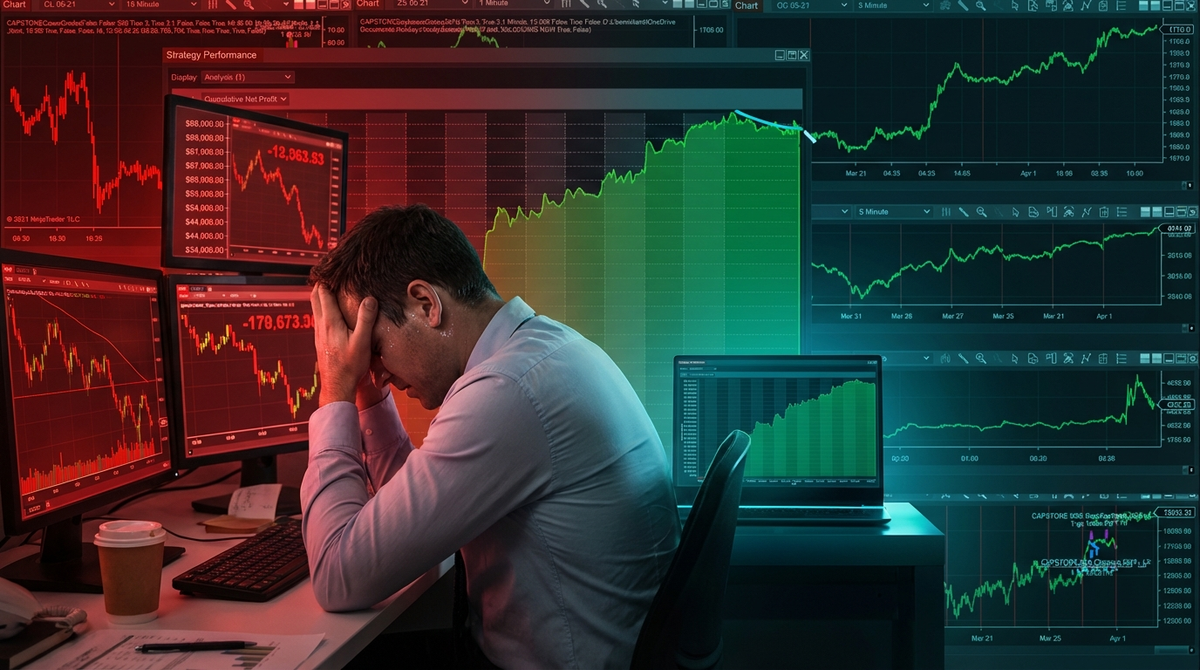
Every futures trader has been there. You take a loss, and instead of walking away, you jump right back in — bigger size, looser stops, desperate to "make it back." Before you know it, one bad trade has turned into five, and your account is bleeding.
A recent post on r/DAYTRADERcollege summed it up perfectly: a trader started with $500, blew through 100 trades in the first week, tried to build discipline with a one-trade-per-day rule, made it three days... then relapsed. Moved their stop once. Then again. Then again. Account destroyed.
Sound familiar?
The uncomfortable truth is that most blown accounts aren't caused by bad strategies. They're caused by overtrading — and the revenge trading spiral that follows. Let's break down why this happens, what the data actually says, and how successful traders solve it.
The Overtrading Epidemic: What the Numbers Say
The statistics are brutal. Studies show that approximately 90% of day traders lose money, and a significant majority blow their entire accounts within the first 90 days. But here's what most people don't talk about: the how.
It's rarely one catastrophic trade that wipes traders out. It's the slow bleed of overtrading — taking 10, 20, even 50+ trades per day when only 1-3 setups actually had edge.
According to research from OANDA and multiple trading psychology studies, overtrading stems from three core triggers:
- Fear of missing out (FOMO) — "The market is moving, I need to be in!"
- Revenge trading — "I just lost, I need to make it back NOW"
- Boredom — "The market isn't doing anything... let me force a trade"
As one veteran trader on r/Daytrading explained after 5+ years in the markets: "When I finally forced myself to go back through my losing trades, the setups weren't the problem. The problem was me. Tired. Stressed. Bored. Trying to make back a loss."
Why "Be Disciplined" Is Useless Advice
Every trading book, YouTube video, and Reddit post tells you the same thing: just be disciplined. Follow your rules. Stick to the plan.
But as that same r/Daytrading poster put it: "Everyone says it. Nobody tells you how. Discipline isn't something you just decide to have. It's a system you build."
This is the critical insight that separates traders who survive from those who blow up. Discipline isn't a personality trait — it's an engineered system that removes the opportunity to break rules.
The Revenge Trading Spiral
- Good setup → loss — Normal. Every strategy has losses.
- Emotional reaction — "That shouldn't have happened. The market is wrong."
- Impulse trade — Jump back in without a setup, bigger size
- Second loss — Now you're down twice as much
- Full tilt — Move stops, add to losers, abandon all rules
- Account blown — "I'll do better next time"
A 10-year trading veteran on r/Trading warned new traders: "Your first job is survival. Forget getting rich this year. Your real goal is to not blow up."
The problem? Most traders understand this intellectually. They know revenge trading will destroy them. They can explain it clearly to someone else. But in the heat of the moment — with real money on the line and the adrenaline pumping — knowledge evaporates.
What Actually Causes Overtrading
Understanding the psychology helps, but let's get specific about the mechanisms:
1. No Hard Trade Limit
If your trading plan says "1-3 trades per day" but nothing physically prevents you from taking trade #4, #5, or #15 — you will eventually break the rule. It's not if, it's when.
The trader on r/DAYTRADERcollege proved this perfectly. They set a one-trade-per-day rule. Made it three days. Then relapsed because there was nothing stopping them except willpower — and willpower is a depleting resource.
2. Confusing Activity With Productivity
Many traders equate screen time with progress. If you're watching charts for 8 hours, you feel like you should have something to show for it. This leads to forcing trades in conditions that don't match your edge.
As OANDA's research notes: "Overtrading often stems from an urge to be constantly in the market, chasing every perceived opportunity."
3. Loss Aversion on Steroids
Behavioral economics tells us that losses feel roughly twice as painful as equivalent gains feel good. In trading, this creates a devastating feedback loop:
- A $200 loss feels like a $400 problem
- The "need" to recover intensifies
- Risk management goes out the window
- The next loss is bigger, making the problem worse
4. No Separation Between Analysis and Execution
When the same person watching the chart is also clicking the buy button, every price movement becomes a potential trade. Professional trading desks solved this decades ago by separating analysts from executors. Most retail traders are doing both simultaneously — while also fighting emotions.
How Top Traders Actually Solve Overtrading
Here's where it gets actionable. The traders who survive and thrive don't rely on willpower. They build systems that make overtrading impossible.
Set Hard Daily Limits (And Enforce Them)
Not suggestions. Hard stops.
- Maximum trades per day: 1-3
- Maximum daily loss: predetermined dollar amount
- Maximum drawdown: walk away and don't return
The key word is enforce. Some traders have their spouse change their platform password after they hit a loss limit. Others use software that locks them out. Whatever it takes.
Journal What Matters (Not Just P&L)
As the r/Daytrading community has emphasized: tracking entries, exits, and profit/loss is just bookkeeping. Real journaling asks:
- Why did I take this trade?
- How was I feeling before I clicked the button?
- Did I follow my rules?
- Was this a setup or an impulse?
One trader noted their win rate when well-rested and calm was 15-20% higher than when tired or emotionally compromised — same setups, completely different results.
Trade Smaller Than You Think You Should
The 10-year veteran on r/Trading was blunt: "Trade small. Smaller than you think you need. Don't max leverage just because the platform lets you."
When position sizes are small enough that losses don't trigger emotional responses, you remove the primary catalyst for revenge trading. You can think clearly, evaluate objectively, and walk away without feeling destroyed.
Take a One-Trade-Per-Day Approach
One of the most effective anti-overtrading strategies is brutally simple: take one trade per day, then walk away.
This approach works because:
- It forces selectivity (you'll only take A+ setups)
- It eliminates revenge trading (you're done after one trade)
- It reduces screen time and emotional fatigue
- It compounds over time with consistency
Whether that single trade wins or loses, you're done. The market will be there tomorrow.
→ This is exactly the philosophy behind StealthScalp from Trinity Trading — a fully automated NinjaTrader 8 strategy that takes one trade per day. No second-guessing, no revenge trading, no emotional spirals. The automation executes the plan whether you're at the screen or not.
Automate to Remove Yourself From the Equation
Here's the uncomfortable reality: you are the weakest link in your trading system.
Your strategy probably works. Your rules probably make sense. The problem is the human executing them — you — under emotional pressure, with real money on the line, running on 4 hours of sleep after a fight with your spouse.
This is why automated trading has exploded in popularity, especially among prop firm traders. When a bot executes your strategy:
- It doesn't revenge trade
- It doesn't move stops because it "feels" like the market will reverse
- It doesn't take 100 trades when the plan says 1
- It doesn't trade bigger after a loss
- It doesn't trade at all when conditions don't match
As one r/Daytrading veteran wisely noted: "Consistency comes from knowing yourself, not finding the perfect strategy." And the ultimate form of self-knowledge? Admitting that your emotions are the problem — and engineering them out of the equation.
→ StealthScalp automates this entire process — designed specifically for NinjaTrader 8 futures traders who want prop-firm-friendly execution without the emotional baggage.
The "I Know But I Can't Stop" Problem
Perhaps the most relatable insight from the Reddit trading community came from a trader who wrote: "I knew revenge trading was killing me. I knew I traded worse when I was tired. I knew I sized up too aggressively after a win. I knew all of it. I just didn't want to write it down and face it because that meant I'd have to actually change."
This is the real barrier. Not knowledge. Not strategy. Willingness to change how you operate.
For some traders, that means:
- Strict checklists taped to their monitor
- Trading only during specific hours
- Having an accountability partner review their trades
- Using automation to remove discretionary decisions entirely
There's no single right answer. But the wrong answer is doing what you've always done and expecting different results.
When to Walk Away (It's Not Weakness)
One of the most powerful things discussed across r/Daytrading and r/FuturesTrading is the concept that not trading is a position.
- Bad sleep? No trade.
- Stressed about personal life? No trade.
- Already hit your daily loss limit? Done for the day.
- No clear setup? No trade.
As one trader framed it: "Some of my best trading decisions were deciding not to trade. The market is there tomorrow. Your capital might not be if you keep forcing it."
This mindset shift — from "I need to trade every day to make money" to "I need to preserve capital to trade another day" — is what separates the 10% who survive from the 90% who don't.
The Bottom Line
Overtrading isn't a knowledge problem. Every trader who's ever blown an account knew they were breaking their rules while they were doing it. It's a systems problem — and it requires a systems solution.
Whether you implement hard daily limits, adopt a one-trade-per-day approach, bring in an accountability partner, or remove yourself from execution entirely through automation — the answer is the same: stop relying on willpower and start relying on structure.
The market rewards consistency. Not activity. Not screen time. Not the number of trades you take. Consistency.
→ Ready to take the emotion out of trading? Explore StealthScalp — Trinity Trading's fully automated NinjaTrader 8 strategy built for prop firm traders who want one clean trade per day, executed without the emotional baggage.
This article was inspired by real discussions from the r/Daytrading, r/FuturesTrading, and r/Trading communities. The experiences shared by traders in these forums reflect the universal challenges of maintaining discipline in the markets.