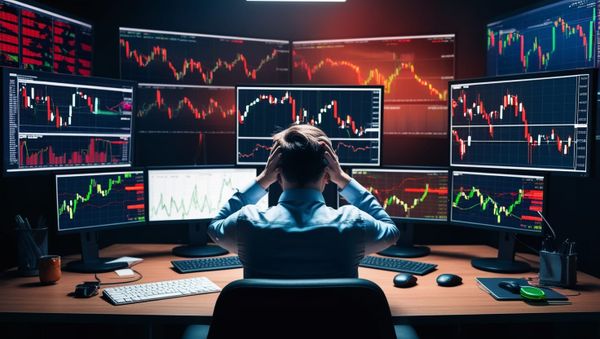
How to Know When to Take a Break from Trading (And Why It Might Be the Best Trade You Ever Make)


Most traders will tell you their worst losses didn't come from a bad setup. They came from trading when they shouldn't have been trading at all.
Exhausted. Emotional. Desperate to get back what the market took. Sound familiar?
Knowing when to stop trading is one of the most underrated skills in this business. It doesn't show up in backtests. Nobody teaches it in YouTube courses. But every funded trader who's lasted more than a year will tell you: the ability to walk away is what kept them in the game.
This guide breaks down the clear warning signs you need a break, how long that break should be, what to do with that time, and how to come back without falling into the same traps.
Why Trading Burnout Hits Harder Than People Think
Trading isn't like most jobs where you can coast when you're tired. When you're mentally depleted and still clicking buttons, you're not just underperforming—you're actively destroying capital.
The problem is that burnout creeps in gradually. It doesn't announce itself. One day you're executing your plan cleanly, and a few weeks later you're revenge trading after a loss at 4 PM wondering how you got here.
Here's the core issue: trading is a decision-making sport, and decision-making is a finite resource. Research on cognitive depletion shows that the more decisions you make throughout the day, the worse your later decisions become. Traders call this "going on tilt" — but science calls it decision fatigue.
For prop firm traders specifically, the stakes are amplified. Daily loss limits. Drawdown thresholds. Profit targets breathing down your neck. That invisible pressure compounds stress in ways you don't even notice until you've failed an eval for the third time.
The 7 Clear Signs You Need to Step Away
Don't wait until you've blown an account to recognize these. The earlier you catch them, the cheaper the lesson.
1. You're Revenge Trading After Losses
You took a loss. It stings. And instead of closing the platform and reviewing what happened, you're already in another position — bigger size, less patience, no real setup.
That's revenge trading. And it's the single fastest way to turn a bad day into a catastrophic one.
The psychological trigger here is emotional anchoring: your brain refuses to accept the loss as final, so it demands immediate action to "fix" it. That urgency is not a trading signal. It's a stop signal.
→ Rule of thumb: If you feel the pull to "make it back today," close the platform. Full stop.
2. You're Deviating From Your Trading Plan
You have a system. You've tested it. You know how it behaves. But lately you keep finding reasons to override it — taking trades outside your setup criteria, holding losers longer, cutting winners short.
When execution drift starts showing up consistently, it's rarely a strategy problem. It's a mental state problem. Your discipline is eroding because your mental reserves are empty.
3. Your P&L Is Controlling Your Mood
Green day → great mood. Red day → everything is terrible.
This emotional volatility linked to P&L is a major red flag. Professional traders learn to detach their emotional state from individual trade outcomes. When you can't do that — when a loss ruins your afternoon or a win makes you overconfident — your psychology is compromised.
You'll almost certainly make worse decisions when your emotional state is wired to every fluctuation in your account balance.
4. You're Overtrading
Your average used to be 2-3 setups per day. Now you're in 10 trades before noon. You're scanning for any excuse to enter the market because sitting on your hands feels intolerable.
Overtrading is rarely about opportunity. It's about needing to feel active, needing to feel in control. The market doesn't care about your need for action — and excessive trading churns your account through commissions and suboptimal setups.
5. You're Dreading the Trading Session
You used to be excited to sit down and watch the open. Now there's a low-grade dread the night before. You open the charts and immediately feel tense.
That dread is your nervous system telling you something important. When an activity you genuinely care about starts triggering avoidance behavior, you're deep into burnout territory.
6. Small Decisions Feel Overwhelming
Should I take this trade? Is this the right size? Should I move my stop?
These micro-decisions that used to feel automatic now feel paralyzing. You second-guess everything. You freeze at the entry. You're in analysis paralysis on setups that would normally be obvious.
This is classic cognitive overload — your brain's decision-making hardware is running on fumes.
7. You've Had Three or More Losing Days in a Row
Three consecutive losing days isn't automatically a signal to stop — sometimes the market is just choppy and your edge doesn't apply. But three losing days in a row is a reliable checkpoint to pause, zoom out, and ask honest questions.
Are the losses part of normal drawdown within your expected parameters? Or are you noticing behavioral patterns (overtrading, deviating from plan, revenge trading) across those sessions?
If it's the second — it's time to stop, not just review.
Types of Trading Breaks: Matching the Break to the Burnout
Not all breaks are equal. The intensity of your burnout determines the length and nature of the break you need.
The Micro-Break (Same Day)
When you're frustrated after a loss or feel impulsive before a session ends:
- Close the platform entirely (not just minimize it)
- Get up from your desk — physically leave the trading area
- 15-30 minutes of any non-market activity: walk, food, anything
- Return only if your head is clear and you can articulate a specific setup you're waiting for
This is your circuit breaker for in-session spirals. Use it aggressively.
The Day Break (1-3 Days)
When you've had a rough week and notice persistent behavioral issues:
- No charts, no market news, no CNBC in the background
- Journal what happened — not your P&L, but your behavior
- Review whether your losses came from bad setups or bad execution
- Return with a specific commitment: "I will only take X setup on Y instrument"
The Week Break (5-10 Days)
When dread, emotional volatility, and decision fatigue have been accumulating for weeks:
- Full mental reset — genuinely disconnect from markets
- Address the physical side: sleep, exercise, social interaction
- Use this time to rebuild strategy conviction, not to read more trading content
- Come back with a smaller size and a narrow, specific focus
The Extended Break (1 Month+)
This is rare but sometimes necessary — especially after a serious account drawdown, a blown eval, or when you've genuinely lost faith in your approach.
An extended break is not quitting. It's strategic recovery. Many professional traders take weeks off each quarter by design — not because they failed, but because they know rest is performance maintenance.
What to Actually Do During Your Break
The biggest mistake traders make when they take a break: they don't actually break. They watch market recaps. They scroll trading Twitter. They're "just reviewing charts, not trading."
That's not a break. That's the same cognitive load with zero upside.
Here's what actually helps:
Journal Your Behavioral Patterns (Not Your P&L)
Write down the honest answer to: What behavior patterns showed up in my last 20 trades?
Don't focus on whether trades won or lost. Focus on whether you executed your plan. This distinction is what separates professional process review from emotional self-flagellation.
Rebuild Your Physical Base
Decision fatigue, emotional volatility, and cognitive fog are mental symptoms — but they have physical causes. Sleep deprivation, poor nutrition, and lack of exercise will shred your trading psychology faster than any bad setup ever could.
Use your break to recover your physical foundation. It sounds basic because it is. And it works.
Re-Examine Your Edge
Come back to first principles. Why does your setup work? What market condition does it require? When does it fail?
If you can't answer those questions with conviction, the break should include rebuilding that understanding — not more screen time, but genuine strategy review.
Reconnect With Why You Started
Trading burnout has a way of making you forget why you got into this. The financial freedom, the independence, the intellectual challenge. Reconnecting with your original motivation can rebuild the emotional fuel you need to trade well.
How to Come Back Without Repeating the Same Mistakes
Coming back wrong is almost as bad as not taking a break at all. Here's a structured return process.
Start Small
Cut your position size in half for your first week back. This isn't lack of confidence — it's smart reintegration. You want to rebuild execution habits without significant capital at risk while you recalibrate.
Set Hard Daily Loss Limits Before the Session Opens
Pre-commit to a dollar amount you're willing to lose today. If you hit it, you're done. No exceptions. Build the discipline of stopping before your session, not during emotional heat.
Trade One Setup Only
For your first 1-2 weeks back, pick your single highest-probability setup and trade only that. Narrowing your focus reduces cognitive load and helps rebuild clean execution habits before adding complexity back.
Track Behavior, Not Just Results
Rate each session on execution quality: Did you follow your plan? Did you manage emotions appropriately? Did you exit when you said you would?
Winning trades from bad process and losing trades from good process are both data points. Your job is to improve the process. The results follow.
The Automation Angle: What If You Didn't Have to White-Knuckle Every Trade?
Here's something worth thinking about: a lot of trading burnout doesn't come from the market — it comes from the execution process itself.
Watching every tick. Managing entries manually. Fighting the urge to move stops. Sitting through drawdown while staring at a flashing P&L. That's not just stressful — it's cognitively exhausting in a way that manual execution will never fully solve.
This is exactly why automated trading strategies have become so popular among serious prop firm traders. When execution is handled algorithmically, you remove the most emotionally-taxing part of the process entirely.
You're not watching every candle. You're not debating whether to exit. You're not second-guessing the entry in real time. The system runs the plan, and you review results — not manage emotions through every tick.
→ StealthScalp is a fully automated NinjaTrader 8 trading strategy built specifically for futures prop firm traders. One trade per day, ICT-inspired logic, built-in end-of-day flatten and fixed R:R targets. It handles execution so your psychology isn't tested by every market movement. See how it works →
The Bottom Line: Stepping Away Is a Skill
The traders who last in this business aren't the ones who grind through burnout. They're the ones who recognize it early, take decisive action, and come back with a clear head.
Taking a break isn't weakness. It's risk management applied to your most important trading instrument: your own psychology.
If you've been grinding through warning signs hoping the market will cooperate and fix your mood, it won't. The market is indifferent. Your psychology is not.
Step away. Reset. Come back sharper.
And if the execution stress is the root of your problem — consider whether automation could reduce the cognitive load that's burning you out in the first place.
→ Curious how StealthScalp removes execution stress from prop firm trading? Learn more here →