What 5 Years of Day Trading Actually Teaches You (And the Shortcut Most Traders Miss)

What 5 Years of Day Trading Actually Teaches You (And the Shortcut Most Traders Miss)
Inspired by a viral r/Daytrading post with hundreds of upvotes
A veteran trader recently dropped a brutally honest breakdown on Reddit about what 5 years of day trading really teaches you. The post resonated with hundreds of traders because it nailed something most beginners don’t want to hear: the edge isn’t in your strategy — it’s in managing yourself.
Let’s break down each lesson and reveal the shortcut that most traders never discover.
Lesson 1: One Boring Setup Beats Five Exciting Ones
“When I started, I wanted to trade everything. Breakouts, reversals, VWAP, news, momentum, all of it. My results were all over the place.”
This is the trader’s version of shiny object syndrome. Every new setup looks like the missing piece. But as the original poster discovered, mastery comes from repetition, not variety.
The fix? Commit to one setup and trade it until you can recognize it in your sleep. Stop seeing charts and start seeing behavior.
The automation angle: A well-coded trading bot doesn’t get distracted by exciting setups. It executes one logic, one way, every single time. No FOMO. No “just this once.” Pure repetition.
→ StealthScalp runs one ICT-based setup daily — the same way, every time
Lesson 2: Risk Management ISN’T Part of the Strategy — It IS the Strategy
“What changed things was treating risk like a fixed cost of doing business. Same dollar risk per trade. Same max loss per day. No exceptions.”
Most blown accounts don’t come from bad analysis. They come from sizing up on “perfect” setups, removing stop losses “just this once,” or revenge trading after a loss.
The Reddit poster nailed it: once your downside is capped, your edge actually gets a chance to play out.
The automation angle: Automated strategies don’t negotiate with stop losses. The risk is baked into the code. Fixed R:R. EOD flatten. No exceptions because a human felt confident.
Lesson 3: Most Bad Trades Come from Boredom, Not Bad Reads
“Some of my worst losses had nothing to do with analysis. They came from forcing trades when nothing was setting up.”
This is the quiet killer of trading accounts. You’re sitting there, watching charts, and nothing is happening. Your finger hovers over the buy button anyway because doing nothing feels wrong.
Overtrading is emotional, not technical. Learning to sit on your hands is harder than learning chart patterns.
The automation angle: A bot doesn’t get bored. It doesn’t click just to feel involved. If the setup isn’t there, it does nothing — and that’s exactly what you should do too.
→ StealthScalp takes exactly one trade per day. No more, no less.
Lesson 4: Journal How You Felt, Not Just What You Traded
“What helped me the most was tracking my emotional state. Was I rushed? Trying to make back a loss? Overconfident after a win?”
Your trading journal should answer: “What was I feeling when I took this trade?”
When you track emotions alongside entries and exits, patterns emerge fast. That “just felt right” trade that lost? You were probably overconfident after a win. That revenge trade? Trying to make back yesterday’s loss.
The automation angle: Automated trading removes the emotional variable entirely. There’s no “felt confident” or “was frustrated.” Just logic executing logic.
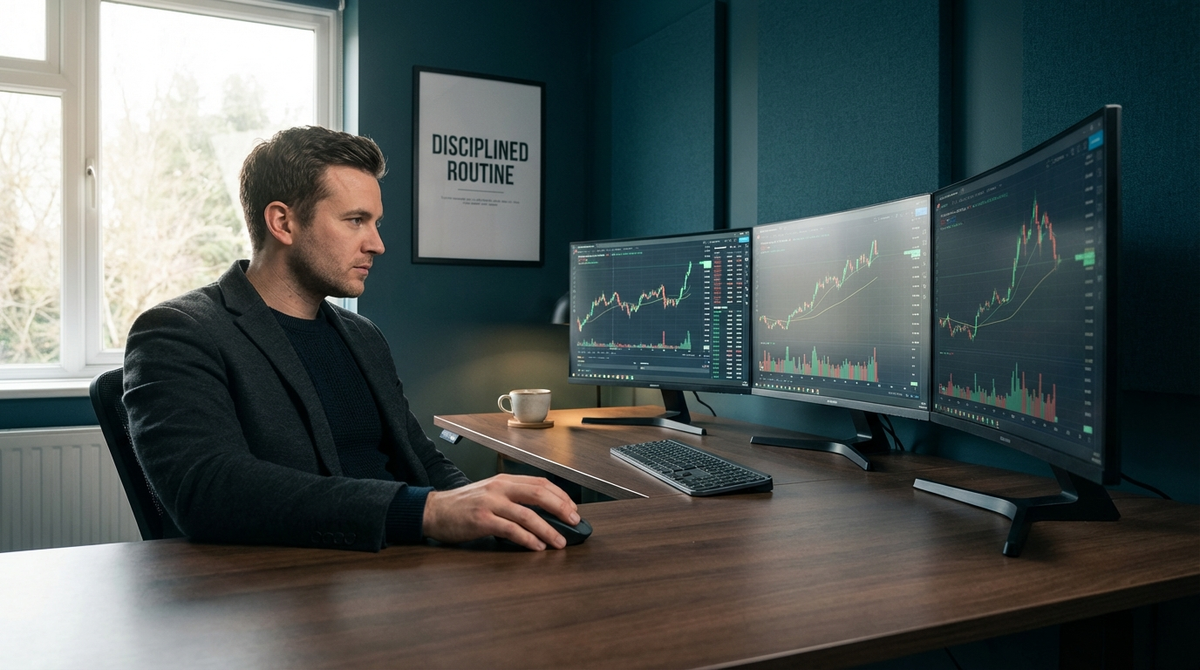
Lesson 5: Consistency Comes from Routine, Not Motivation
“Motivation comes and goes. Routine sticks. Same prep. Same hours. Same rules. I stopped waiting to ‘feel ready’ and just showed up and executed the process.”
This is the hardest lesson for most traders. Waiting until you “feel ready” is a trap. Pros show up and execute whether they’re motivated or not.
The goal is to make trading boring enough that emotions stop running the show.
The automation angle: An automated strategy doesn’t need motivation. It runs the same routine, the same way, every single day. Rain or shine. Monday or Friday. It shows up and executes — exactly what this 5-year veteran is describing.
The Shortcut: Remove Yourself from the Equation
Here’s what’s fascinating about this Reddit post: every single lesson points toward the same solution.
- One boring setup → Automation runs one setup
- Fixed risk, no exceptions → Automation doesn’t negotiate
- No boredom trades → Automation doesn’t get bored
- No emotional leaks → Automation has no emotions
- Routine over motivation → Automation IS the routine
The 5-year veteran spent half a decade learning to trade like a machine.
What if you just… used a machine?
That’s not cheating. That’s understanding where the edge actually lives. Your job becomes oversight, not execution. You design the system, monitor the results, and let the bot handle the part where humans consistently fail.
Why Automation Works for Prop Firm Traders
If you’re trading prop firm evaluations (Apex, TopStep, My Funded Futures, etc.), this is even more critical.
Prop firms have: - Consistency rules — one big day can’t carry your account - Daily loss limits — one bad emotional day can fail you - Trailing drawdowns — discipline isn’t optional
These rules are specifically designed to filter out emotional traders. An automated strategy that runs one trade per day with fixed risk is practically designed for consistency rules.
→ StealthScalp is built for prop firm evaluations
What Actually Matters After 5 Years
The Reddit post ended with this:
“If I had to sum it up, trading got easier when I stopped trying to outsmart the market and focused on managing myself instead.”
That’s the real lesson. And the shortcut? Outsource the part that’s hardest to manage.
You can spend 5 years learning to sit on your hands, journal your emotions, stick to routines, and trade like a machine — or you can put the machine to work on day one.
The edge isn’t in predicting the market. It’s in consistent execution.
And consistent execution is exactly what automation delivers.
Next Steps
If you’re tired of fighting yourself to follow your own rules:
- Audit your trading journal — How many losses came from boredom, revenge, or FOMO?
- Define your one setup — What’s the specific logic you trade best?
- Consider automation — Not as a replacement for learning, but as a tool for execution
→ See how StealthScalp automates one ICT setup per day for prop firm traders
This post was inspired by a viral discussion on r/Daytrading where a 5-year veteran shared hard-won lessons about discipline, risk management, and the unsexy truth about profitable trading.