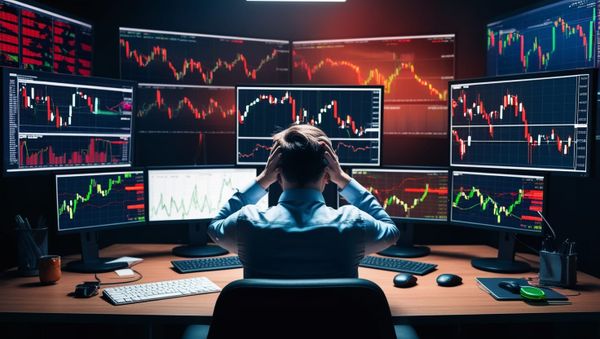
The Walk Away Rule: Why the Best Traders Stop Watching After Entry


The Walk Away Rule: Why the Best Traders Stop Watching After Entry
The counterintuitive habit that separates profitable traders from those who blow up their accounts.
After 5 years of trading mistakes, one Reddit trader finally became profitable. But it wasn't a new indicator or a secret strategy that changed everything. It was one simple rule:
"When my entry hits, I set up the trade and walk away from the chart. I let the trade play out. Win or lose."
This post—which gained over 1,300 upvotes on r/Daytrading—resonated because it revealed a truth most traders know but can't follow: watching your trades is killing your performance.
Why We Can't Stop Watching
You've done everything right. You've identified your setup, calculated your risk, set your stop loss and take profit. The trade is on.
And then you sit there. Staring. For the next 30 minutes—or three hours—you watch every tick.
Why?
Because the human brain wasn't built for this. Evolution gave us a nervous system that responds to immediate threats. When you're in a trade and price moves against you, your brain treats it as a threat to survival. Cortisol spikes. Your heart rate increases. And the longer you watch, the worse it gets.
As one veteran trader on Reddit put it: "I believe many people have winning strategies, it's their psychology that gets in the way of it actually being profitable long term. Removing emotion from the trade makes a massive difference."
The problem isn't your strategy. It's your attention.
The Three Traps of Active Watching
1. The Premature Exit Trap
You're up 15 points. You were targeting 30. But those 15 points feel real right now, and the idea of giving them back feels unbearable.
So you close the trade.
Price continues to your original target—and beyond.
One trader described this pattern perfectly: "I move my stops to the positive after 5-15 mins into the trade if it's going my way... The frustration makes me want to chase the trade."
When you watch, you optimize for emotional comfort, not for your strategy's edge.
2. The Moving Stop Trap
Every time price swings against you, you feel the urge to adjust. Just widen the stop a little. Give it room to breathe.
Three adjustments later, your 20-point stop has become a 60-point stop. Your risk:reward is destroyed. And when price finally hits your (now-massive) stop, the loss is three times larger than it should have been.
Walking away eliminates this trap entirely. No eyes on the chart means no temptation to intervene.
3. The Overtrading Trap
You closed your trade. It was a win. Or maybe it was a small loss. Either way, you're still at your desk. The chart is still open.
And there's another setup. Sort of. Kind of. If you squint.
Before you know it, you've taken three more trades. None of them were your A+ setup. All of them were born from boredom and proximity to the screen.
The top comment on that Reddit thread captured this wisdom: "I don't take more than two trades a day. If the first works out, I call it on one trade and that's the day. Super boring but this has been the way I've remained to be profitable over time."
Boring isn't a bug. It's the entire feature.
What "Walk Away" Actually Looks Like
The trader who shared his transformation laid out a surprisingly simple system:
- Single strategy, never deviate. Keep trading boring.
- Trade one single market (in his case, NAS100). No hunting across multiple pairs.
- Same risk per trade every time. No adjusting based on confidence or recent results.
- When the entry hits, set up the trade and walk away.
- Never revenge trade. The day is done when the trade is done.
The key insight: he backtested his strategy relentlessly. This gave him the confidence to walk away. He already knew the win rate. He already knew the expectancy. Watching any individual trade was adding noise, not signal.
As he explained: "What I find when I speak to those who aren't profitable is they don't track their trades, don't backtest, trading multiple pairs, different strategies every week."
The traders who can't walk away are often the same traders who don't trust their own system—because they've never done the work to validate it.
The Science of Detachment
Trading is one of the few professions where doing more often produces worse results.
In most jobs, effort correlates with output. In trading, obsessive attention often correlates with impulsive mistakes.
Here's what happens physiologically when you watch a live trade:
- Cortisol (stress hormone) increases every time price moves against you
- Dopamine fluctuates with every tick, creating an addictive loop
- Amygdala activation triggers fight-or-flight responses that override rational thinking
- Decision fatigue accumulates, degrading each subsequent choice
Studies on trading psychology consistently find that traders who check their positions less frequently perform better than those who monitor constantly. The less you watch, the more you stick to your plan.
One commenter summarized it bluntly: "Revenge trading, overtrading, pretty much the reason on how most of us get margin called..."
Both problems share a root cause: too much attention, too little structure.
The Walk Away Protocol
If you want to implement the walk away rule, here's a practical framework:
Before the Trade
- Define your setup clearly. If you can't explain it in one sentence, it's too complicated.
- Backtest until you trust it. You need to know the expectancy before you can ignore individual results.
- Decide your stop loss and take profit based on structure. As one trader noted: "The structure dictates the SL, the SL placement dictates the size."
During the Trade
- Enter the trade. Set your stop. Set your target.
- Walk away. Close the chart. Leave the room. Go for a walk. Start a timer if you need accountability.
- Do not check until the trade is closed. Let the alert come to you.
After the Trade
- Log the result. Win, loss, or scratch—record it.
- Review at the end of the week, not after each trade. Individual trades mean nothing. Patterns over 50-100 trades mean everything.
- Stop for the day. If you've taken your trade(s), you're done.
What About Prop Firm Traders?
If you're trading an evaluation or a funded account, walking away might feel impossible. The trailing drawdown is watching you. Every point matters.
But here's the paradox: prop firm evaluations are where the walk away rule matters most.
Why? Because the rules are already set. Your daily loss limit is predetermined. Your trailing drawdown defines your floor. The firm has essentially built your risk management into the structure.
All you need to do is:
- Size your trades so a normal loss won't breach limits
- Set stops that respect the daily loss limit
- Walk away
The traders who fail evaluations aren't usually failing because of their strategy. They're failing because they can't stop themselves from intervening. They move stops. They take one more trade. They let one bad trade spiral into three.
Walking away prevents the spiral.
The Automation Solution
Some traders eventually realize: if walking away is the answer, why not take myself out of the equation entirely?
This is where automated trading strategies make sense. Not as a replacement for learning—you still need to develop and validate a strategy—but as an enforcement mechanism for discipline.
When a system takes your trades for you:
- There's no temptation to close early
- There's no moving stops "just this once"
- There's no revenge trading after a loss
- Every trade follows the exact same rules
As one trader in the thread noted about emotional detachment: "This for me is the greatest change I made... Learn from your wins and losses. I used to not do that at all which is reckless if you want to win at this long term."
Automation forces you to learn from results because it forces you to examine data rather than memory. Your journal becomes the system's trade log. Your patterns become visible because they're recorded, not felt.
→ At Trinity Trading, StealthScalp automates this discipline entirely. One trade per day, ICT-inspired FVG logic, flat by end of day. You can't revenge trade if the strategy only takes one trade. You can't watch obsessively if the execution is handled for you. It's the walk away rule, enforced by code.
The Hardest Part
Let's be honest: walking away is harder than it sounds.
You've spent hours preparing for this trade. You've analyzed the charts. You've waited for the setup. And now you're supposed to just... leave?
Yes.
Because the preparation was the work. The entry was the decision. Everything after that is just noise until the trade resolves.
The original poster said it best: "Most important: Become emotionally detached from each trade."
Not from trading. From each trade.
You can care deeply about your trading career while remaining indifferent to whether this particular trade wins or loses. In fact, you must. Because the alternative is a career of emotional exhaustion, revenge trades, and slow account destruction.
Your Challenge This Week
If you're skeptical—and you should be—here's a challenge:
For the next five trading days, commit to the walk away rule on every trade:
- Take your setup
- Set your stops and targets
- Close the chart completely
- Do something else for at least 30 minutes
- Only check if you get a fill notification
At the end of the week, compare your results to your normal approach. Look at:
- Win rate
- Average winner vs. average loser
- Number of trades (fewer is usually better)
- Emotional state after trading hours
Most traders who try this report two things: better results, and—surprisingly—more enjoyment. Turns out, trading without the stress of watching every tick is actually a better experience.
The Bottom Line
The traders who survive long enough to become profitable share a common trait: they've learned to stop watching.
Not because they don't care. Because they've realized that watching doesn't help. The trade will play out whether you watch or not. The only variable you change by watching is your likelihood of making a mistake.
As that 5-year veteran put it: "I set up the trade and walk away. I let the trade play out. Win or lose."
Simple. Boring. Profitable.
Maybe it's time you stopped watching.
The walk away rule is one of trading's hardest lessons because it goes against every instinct. If you want to enforce this discipline automatically, StealthScalp removes the temptation entirely—one trade per day, executed without emotion. Learn more at trinitytrading.io.