Trading FOMO: Why It Destroys Your Edge and How to Conquer It

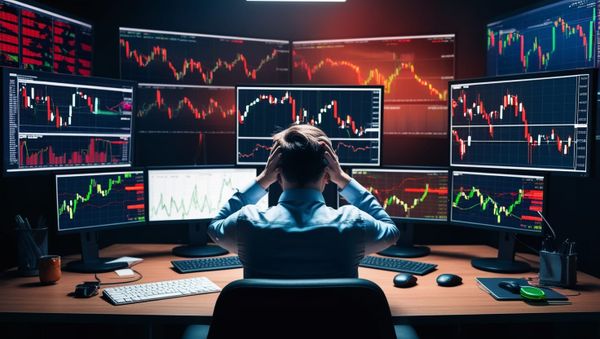
Every trader knows the feeling. You're watching the chart, price breaks out without you, and suddenly your finger is hovering over the buy button—even though your setup never triggered.
That's FOMO. The Fear of Missing Out. And it's quietly responsible for more blown accounts than bad strategies ever will be.
In this guide, we'll break down exactly why FOMO destroys your trading edge, how to recognize it in real-time, and the specific steps you can take to conquer it for good.
What Trading FOMO Actually Looks Like
FOMO in trading isn't just "feeling bad about a missed move." It's a psychological trigger that overrides your trading plan and forces impulsive decisions. Here's what it looks like in practice:
- Chasing entries — Jumping into a trade after it's already moved 50-80% of its expected range
- Widening stops — Moving your stop loss further away because you "don't want to get stopped out before the move"
- Oversizing positions — Taking a bigger position than normal because "this one is definitely going to work"
- Breaking your rules — Taking trades outside your setup criteria because the chart "looks good"
- Revenge trading — Taking another trade immediately after a loss to "make it back"
If you've done any of these, you're not alone. A thread on r/Daytrading with hundreds of responses showed that FOMO is the single most common psychological struggle traders face—ahead of fear, greed, and even overtrading.
Why FOMO Destroys Your Edge
Your trading edge exists because of specific conditions. You've backtested a setup. You know the win rate. You know the expected value. That edge only works when you execute it consistently, under the same conditions.
FOMO trades violate every part of that equation.
You Enter at the Worst Possible Price
When you chase a move, you're entering after the move has already happened. Your risk-to-reward ratio is destroyed before the trade even begins. A setup that normally offers 3:1 reward-to-risk becomes 1:1 or worse when you chase it by 10-15 ticks.
Your Win Rate Drops Dramatically
FOMO trades aren't part of your tested system. They're emotional reactions. Even if your strategy wins 55% of the time under normal conditions, FOMO trades might win 30-35% of the time—because you're entering late, with poor structure, and without confirmation.
It Creates a Destructive Feedback Loop
Here's where it gets dangerous:
- You miss a trade → feel FOMO
- You chase the next one → it loses
- Now you're frustrated → revenge trade
- That loses too → you're tilted
- You take three more bad trades trying to recover
- Day is blown → emotional damage carries into tomorrow
One moment of FOMO can cascade into a week-long drawdown. Experienced traders on Reddit's r/FuturesTrading call this the "FOMO spiral"—and most say it's responsible for their worst trading months.
The Psychology Behind Trading FOMO
Understanding why your brain does this is the first step to beating it.
Loss Aversion Is Hardwired
Behavioral economics research (Kahneman & Tversky) shows that humans feel the pain of a loss roughly twice as intensely as the pleasure of an equivalent gain. Missing a winning trade feels like a loss—even though you didn't lose any money. Your brain treats "missed profit" the same way it treats actual losses.
Social Comparison Amplifies It
If you're in trading Discord servers, Twitter/X feeds, or group chats, you're constantly exposed to other people's wins. Someone posts a screenshot of a 100-tick runner and suddenly your perfectly valid 20-tick scalp feels inadequate. Social media turns FOMO into a chronic condition.
Recency Bias Makes It Worse
You remember the one trade you missed that ran 200 ticks. You don't remember the 15 times you chased and lost. This creates a distorted picture where chasing "feels" profitable—even when your account history proves otherwise.
7 Practical Steps to Conquer Trading FOMO
Knowing the problem isn't enough. Here are concrete, actionable steps that actually work.
Step 1: Build a Pre-Trade Checklist
Before every single trade, run through a physical checklist. Write it down. Tape it to your monitor. The checklist should include:
- Does this match one of my defined setups? (Yes/No)
- Is the risk-to-reward at least 2:1?
- Am I entering at my planned price—or chasing?
- What is my exact stop loss level?
- What is my exact target?
If any answer is wrong, you don't take the trade. No exceptions. The checklist acts as a circuit breaker between emotion and execution.
Step 2: Set a Maximum Trade Count
One of the most effective anti-FOMO rules is a daily trade limit. Many successful futures traders take only 1-3 trades per day. When you know you only get three shots, you become incredibly selective about which setups you take.
This single rule eliminates:
- Revenge trading (you've used your trades)
- Overtrading (hard cap enforced)
- Chase entries (you can't afford to waste a trade)
Step 3: Journal Every FOMO Urge
When you feel FOMO, don't fight it silently—write it down. Open your trading journal and log:
- What triggered the FOMO?
- What would I have done? (Entry, stop, target)
- Did I act on it? What happened?
After 30 days, review your FOMO journal. You'll almost certainly find that the majority of FOMO trades would have been losers. Hard data beats feelings every time.
Step 4: Use a "Miss It" Rule
If your entry price passes without you, the trade is dead. Don't adjust. Don't chase. Mark it as a missed trade and move on. The market gives you new setups every single day.
As one trader on r/Daytrading put it: "Have a trading plan. Once your plan is working well, you get numb to FOMO and fear."
Step 5: Turn Off Social Media During Market Hours
This is non-negotiable if you're serious about beating FOMO. Close Twitter. Mute the Discord. Your chart is the only input that matters during trading hours.
Other people's trades are irrelevant to your strategy. Their wins don't make your edge better, and their screenshots don't pay your bills.
Step 6: Reframe "Missing" as a Win
Every time you skip a trade that wasn't in your plan, that's a win. You protected your capital. You followed your rules. You preserved your edge for the next valid setup.
Professional traders understand that the best trade is often no trade. Sitting on your hands when nothing matches your criteria is an active, skilled decision—not weakness.
Step 7: Automate Your Strategy
Here's the most powerful anti-FOMO tool that exists: remove yourself from the equation entirely.
When your strategy is automated, there's nothing to FOMO about. The bot takes every valid setup at the exact right price, with the exact right stop, at the exact right size. No chasing. No hesitation. No revenge trades. No spirals.
→ StealthScalp by Trinity Trading is a fully automated NinjaTrader strategy that takes one high-probability trade per day on futures. It doesn't feel FOMO. It doesn't chase. It just executes—consistently, mechanically, every session.
FOMO and Prop Firm Challenges: A Deadly Combination
If you're trading a prop firm evaluation, FOMO becomes 10x more dangerous. Here's why:
- Daily loss limits are tight — One FOMO trade can put you at or past your daily max loss
- Trailing drawdowns punish spikes — Chasing a winner then giving it all back destroys your trailing threshold
- Time pressure amplifies FOMO — "I need to hit target by Friday" makes every missed trade feel catastrophic
- Account resets cost money — Every blown eval from FOMO is another $100-$300 reset fee
The traders who consistently pass prop firm challenges share one trait: extreme discipline. They take their setups and only their setups. They'd rather have a flat day than a blown account.
→ See how StealthScalp handles prop firm evaluations — automated execution means zero emotional interference with your challenge.
The "One Trade Per Day" Mindset
Many elite traders have adopted a simple philosophy: one good trade per day is enough.
Think about it. If you average just 10 ticks per day on NQ futures (one contract), that's:
- $50/day per contract
- $1,000/month with 20 trading days
- $12,000/year from a single daily trade
Scale to 5 contracts and that's $60,000/year—from taking one trade, once a day. No FOMO required. No 8-hour screen time. No emotional rollercoasters.
This mindset shift is transformative. When you stop trying to catch every move and focus on catching one great setup, FOMO loses its power over you.
Signs You've Conquered FOMO
How do you know when you've beaten it? Look for these signs:
- You watch a move happen without you and feel nothing
- You close your platform after your max trades, even on a red day
- You take zero trades on days with no valid setups—and feel good about it
- Your position sizing is consistent, not emotional
- Your journal shows fewer impulsive entries month over month
This doesn't happen overnight. It's a skill you develop through repetition, journaling, and honest self-assessment.
The Bottom Line
FOMO is normal. Every trader experiences it. But the difference between profitable traders and the 90% who fail is what they do with that feeling.
The traders who win long-term have systems—both mechanical and psychological—that prevent FOMO from reaching the order button. Whether that's a checklist, a trade limit, a journal, or full automation, the solution is the same: put something between the impulse and the execution.
→ Ready to eliminate FOMO from your trading? StealthScalp automates your futures trading with one disciplined trade per day. No chasing. No emotions. Just execution.