Why Scared Money Never Wins Is the Realest Trading Advice You'll Ever Get

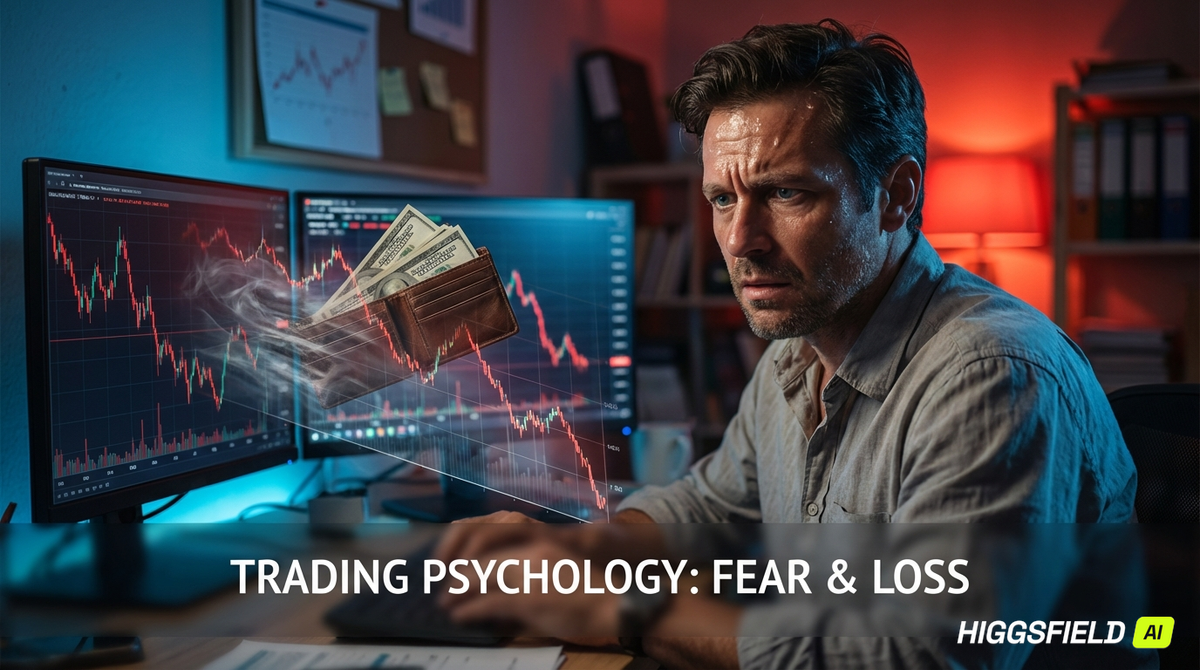
A trader recently posted something brutally honest on r/FuturesTrading that stopped me in my tracks:
“I finally realized it. I can’t succeed at trading because I can’t afford to lose. Every dollar I risk actually means something to me and so my judgement is always clouded.”
This hit home for thousands of traders. Because it’s true.
But here’s what that trader — and maybe you — might be missing: the solution isn’t “get rich first, then trade.” There are practical ways to escape the scared money trap today.
Let’s break down what’s really happening psychologically, why this problem destroys more traders than bad strategy ever will, and what you can actually do about it.
What “Scared Money” Actually Does to Your Brain
When you’re trading money you can’t afford to lose — rent money, savings you need, or capital that represents months of sacrifice — your brain literally changes how it processes decisions.
The Amygdala Hijack
Your amygdala (the fear center of your brain) activates when it perceives a threat to your survival. And here’s the thing: your brain doesn’t distinguish between a sabertooth tiger and watching your $500 account drop $50.
When you’re trading scared money, every red candle triggers a survival response:
- Cortisol floods your system. Your heart rate increases, your palms sweat, and your decision-making shifts from logical analysis to fight-or-flight reactions.
- Your prefrontal cortex (rational thinking) gets suppressed. You literally lose access to the part of your brain that would help you stick to your plan.
- Time perception distorts. That 3-minute pullback feels like an hour. You exit early because you can’t handle the discomfort.
As one trader put it in the comments: “This is deep thought, it’s valid, it’s the path to success.”
Loss Aversion on Steroids
Behavioral economists have shown that humans feel losses roughly 2x more intensely than equivalent gains. But when you’re trading money you can’t afford to lose? That multiplier goes through the roof.
A $100 loss feels like a $300 loss when that money represents groceries. A $500 loss feels like a $1,500 loss when it’s your car payment.
This creates a devastating pattern: - You cut winners too early (taking any profit feels like a “win” you can’t risk giving back) - You hold losers too long (closing the trade makes the loss “real”) - You avoid valid setups entirely (the pain of potential loss stops you from entering)
The “Rich Get Richer” Trap (And Why It’s Not the Full Picture)
The original poster concluded: “The only people really successful at trading are people who are already well off/rich, so it’s basically a game to them and not life/death.”
There’s truth here. But it’s not the whole story.
Yes, trading is easier when losing doesn’t hurt. But “being rich” isn’t the only way to get there. The key insight is this:
You don’t need to be wealthy. You need to be detached from the outcome.
Wealthy traders have outcome detachment by default — $1,000 doesn’t change their life either way. But there are other paths to the same mental state:
- Risk capital only — Trade with money you’ve already mentally “spent”
- Position sizing — Make each trade small enough that losing doesn’t trigger survival mode
- Use someone else’s capital — Prop firms let you trade meaningful size without personal financial risk
- Automate decisions — Remove yourself from the execution entirely
Let’s dig into each.
Solution #1: The “Set It on Fire” Rule
Here’s a rule that changes everything: Your trading capital should be money you could set on fire without changing your life.
Sounds extreme? It’s the only standard that works.
If losing your trading account would: - Force you to skip rent - Prevent you from buying groceries - Cause relationship problems - Keep you up at night
…then you’re trading scared money. Period.
How to Apply This
- Calculate your monthly essential expenses. Not wants — needs. Rent, food, utilities, minimum debt payments.
- Build a 3-month emergency fund first. Non-negotiable. This money doesn’t exist for trading.
- Only trade what’s left after that. Even if it’s $200.
“But I can’t grow an account with $200!”
You’re right. But you can learn with $200. And learning without fear is 10x more valuable than learning while your nervous system screams at you.
Solution #2: Position Sizing That Removes Fear
Even if your total account is money you can afford to lose, individual trades can still trigger scared money psychology if they’re too large.
The 1% Rule (And Why Most Traders Break It)
The standard advice: Risk no more than 1-2% of your account per trade.
With a $5,000 account, that’s $50-100 per trade. With $1,000, it’s $10-20.
Most traders break this rule because: - Small wins feel meaningless - They want to “make back” previous losses - They see big gains online and want the same
But here’s what happens when you follow it: - You can be wrong 10+ times in a row without significant damage - Your nervous system stays calm during drawdowns - You make logical decisions because survival mode never activates
The Psychology of “Small”
One trader shared their breakthrough: “I started trading one MES contract instead of ES. Same setups, same strategy. But suddenly I could actually follow my rules because losing $25 didn’t make me want to vomit.”
The money you make per trade is irrelevant if you can’t execute consistently. Small position sizing isn’t a compromise — it’s a prerequisite.
Solution #3: Trade Someone Else’s Money
This is where prop firms change the game entirely.
When you trade a prop firm evaluation: - You’re not risking your life savings. The evaluation fee is the maximum you can lose. - Losing doesn’t spiral. You can’t blow up your rent money because it’s not your capital. - The psychological reset is real. Most traders report they execute their strategy better on eval accounts than personal accounts.
And once you’re funded: - You’re trading the firm’s capital, not yours - Your downside is capped (you lose the account, not $50K of your own money) - You can focus on execution instead of financial survival
The Prop Firm “Scared Money” Paradox
Here’s something interesting: traders often feel less pressure on $150K funded accounts than $2,000 personal accounts.
Why? Because the $2,000 personal account represents sacrifice. They saved for months, skipped expenses, told themselves this was their shot. Every dollar feels heavy.
The $150K funded account? It’s the firm’s money. The trader already “paid” (the eval fee) and has nothing left to lose financially. They can just… trade.
This psychological shift is worth the cost of a dozen evaluation resets.
Solution #4: Remove Yourself From Execution Entirely
Here’s the nuclear option for scared money: don’t trade manually at all.
If your brain can’t be trusted not to interfere — and most brains can’t — then take your brain out of the equation.
Automated trading strategies: - Execute entries exactly as defined (no hesitation, no “maybe I’ll wait”) - Take every stop loss without negotiation (no “it’ll come back”) - Take profits at predetermined levels (no “I’ll let it run a bit more”) - Don’t care if the money is “scared” or not
You still need a valid strategy. Automation doesn’t create edge out of thin air. But if you already have a working strategy that you consistently fail to execute because of emotional interference?
Automation isn’t a luxury. It’s the solution.
→ StealthScalp runs one automated trade per day on NinjaTrader 8 using ICT-inspired FVG logic. It’s designed specifically for traders who know their edge but can’t stop themselves from interfering with it. Learn more
The Real Problem Isn’t Money — It’s Attachment
Let’s zoom out.
The scared money problem isn’t really about how much capital you have. It’s about attachment to outcomes.
You can be scared with $1 million if that million represents your retirement. You can be fearless with $500 if that $500 is truly “play money.”
The work isn’t just financial — it’s psychological: - Detach your identity from your P&L. You are not your trading results. - Accept that any individual trade is meaningless. It’s a statistical sample, nothing more. - Understand that the money is already gone. The moment you fund a trading account, consider it spent. What you’re buying is the opportunity to execute a strategy.
What Actually Changes Things
Here’s the honest truth: reading this article won’t fix scared money psychology. Neither will any other article, course, or YouTube video.
What actually works:
- Get your financial house in order. Emergency fund first. Always.
- Trade small enough that losses don’t hurt. For real. Even if it feels pointless.
- Use prop firm capital instead of personal money whenever possible.
- Automate what you can to remove emotional decision-making.
- Journal your emotional states alongside trades. See the pattern. Then address it.
The trader who posted that realization on Reddit was at a crossroads. They could quit, or they could find a way to trade without fear.
→ If you have a strategy that works but can’t execute it consistently, automation might be your answer. StealthScalp handles one trade per day — entry, stop, and target — so you never have to trade scared again. See how it works
Final Thought
Scared money never wins. Not because the strategy is wrong, but because fear makes good execution impossible.
The solution isn’t “get rich first.” It’s restructure your trading so that losing doesn’t activate survival mode.
Trade smaller. Trade prop firm capital. Automate decisions. Build systems that don’t require your nervous system to cooperate.
Because the market doesn’t care if you’re scared. It’ll take your money either way.
The difference is whether you give it away from fear — or lose it as a calculated cost of doing business.
Struggling to execute your strategy because emotions get in the way? You’re not alone. StealthScalp automates one ICT-inspired trade per day on NinjaTrader 8 — removing you from the emotional equation entirely. Learn more at trinitytrading.io