QuantVue vs StealthScalp: Which Automated Trading System Actually Delivers?
An honest, in-depth comparison of QuantVue and StealthScalp — two fundamentally different approaches to automated prop firm trading. ICT concepts vs traditional indicators, pricing, automation, and which one is right for you.

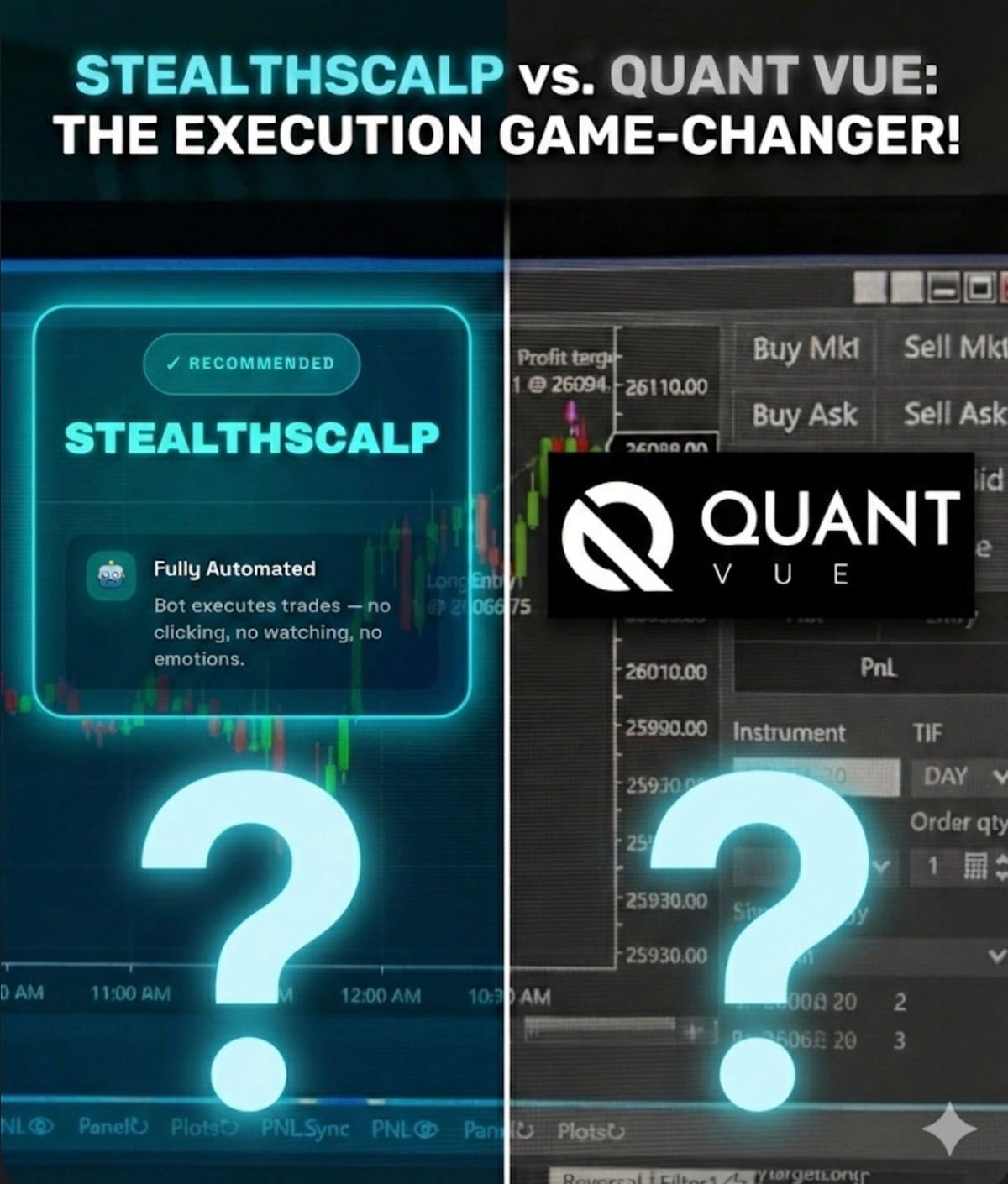
If you're searching for an automated futures trading solution — especially for prop firm evaluations — you've probably come across both QuantVue and StealthScalp by Trinity Trading. They both promise to take the emotion out of trading and automate your execution. But under the hood, these are fundamentally different approaches to the same problem.
We'll break down both systems honestly so you can decide which one fits your trading goals. Full disclosure: we built StealthScalp, so we're biased — but we'll let the differences speak for themselves.
The Core Philosophy: Two Very Different Approaches
QuantVue: Indicator-Heavy, Quantitative Approach
QuantVue offers a suite of indicators and strategies built primarily for TradingView and NinjaTrader. Their system leans heavily on quantitative, indicator-driven logic — think oscillators, adaptive price bands, trend alerts, and signal-based entries.
In our opinion, this approach has a fundamental limitation: most indicator-based systems rely on lagging data. Moving averages, MACD variants, and oscillator-based signals are, by nature, reactive. They tell you what already happened and attempt to project forward. This can work in trending markets, but in choppy, range-bound conditions — which is where most prop firm traders lose their accounts — lagging indicators tend to generate noise.
There's also the overfitting concern. When a system offers dozens of configurable indicators with countless parameter combinations, it becomes very easy to curve-fit a strategy to historical data that looks incredible on a backtest but falls apart in live markets. More knobs to turn isn't always a good thing.
StealthScalp: ICT-Based Smart Money Execution
StealthScalp takes a completely different approach. Instead of relying on traditional indicators, our strategy is built on ICT (Inner Circle Trader) concepts — specifically:
- Fair Value Gaps (FVGs): Identifying institutional imbalances in price action where smart money has left its footprint
- Market Structure Shifts (MSS): Detecting real-time changes in market direction based on how price interacts with liquidity
- Liquidity Sweeps: Understanding where stop losses cluster and how institutions engineer moves to fill orders
The difference is philosophical. ICT concepts are rooted in how markets actually move — driven by institutional order flow, liquidity, and price delivery — rather than mathematical derivatives of past price data. In our view, this gives StealthScalp an edge that doesn't degrade over time the way indicator-based edges tend to.
Moving averages lose their edge as more traders use the same signals. Institutional order flow? That's the market itself. It doesn't get arbitraged away.
Automation: Plug-and-Play vs. Assembly Required
QuantVue
QuantVue provides tools, but you still need to assemble the system yourself. Their offering includes:
- 10+ indicators you configure manually
- Strategies you apply with "copy-paste best settings"
- A separate automation platform (ATS) that costs extra
- QuantLynk for alert-based trade copying
- Requires a paid TradingView plan (most users need Premium)
That's a lot of moving parts. You're essentially buying a toolkit and building your own trading machine. For experienced traders who enjoy tinkering, that might be appealing. But for someone who wants to set it and forget it — especially for prop firm evaluations — it's a lot of complexity.
They also explicitly state their system is not for beginners and requires "baseline trading knowledge and live-trading experience." That's a high barrier to entry for a product that's supposed to automate your trading.
StealthScalp
StealthScalp is one strategy, one setup, fully automated. You install it in NinjaTrader 8, connect your Tradovate account, and it runs. That's it.
- No indicators to configure
- No separate automation platform needed
- No TradingView subscription required
- No manual execution — the bot handles everything from entry to exit
- Works from evaluation through funded account with zero changes
The simplicity is intentional. We believe the best automation is the kind you don't have to think about. One trade per day, end-of-day flatten, fixed risk parameters, prop firm rules baked in. You don't touch it.
Prop Firm Focus
Both systems claim to work with prop firms, but the approach differs significantly.
QuantVue offers prop firm automation as an add-on (their ATS program), which comes with its own pricing and separate refund policy. Their core plans give you indicators and strategies, but automating into a prop firm account requires additional setup.
StealthScalp was built from day one for prop firm evaluations. Every design decision — the one-trade-per-day rule, EOD flatten, trailing drawdown management, consistency rules, contract limits — exists because prop firms require it. There's no separate "prop firm add-on" because the entire product is the prop firm solution.
Pricing Comparison
| StealthScalp | QuantVue | |
|---|---|---|
| Monthly Cost | $98/mo | Varies by plan (Pro/Elite/ATS — reportedly $150-300+/mo) |
| Additional Costs | None | TradingView Premium (~$50/mo), ATS program (additional) |
| True Monthly Cost | $98 | $200-350+ fully equipped |
| Money-Back Guarantee | 30 days, no conditions | 30 days, first-time only, excludes ATS |
When you factor in the TradingView subscription and the ATS automation add-on that most prop firm traders would need, QuantVue's total cost can be 2-3x higher than StealthScalp for a comparable level of automation.
The Overfitting Problem (Our Honest Opinion)
This is where we have to be direct about our perspective.
We believe that indicator-heavy systems with dozens of configurable parameters are prone to overfitting. When you can tweak oscillator lengths, moving average periods, band widths, and signal thresholds across 10+ indicators, it's almost impossible not to find settings that look perfect on historical data.
The problem? Markets change. The settings that crushed it on last year's NQ data may underperform next quarter when volatility shifts or market structure changes. This is the fundamental weakness of quantitative, indicator-driven approaches — they optimize for the past, not the future.
ICT concepts, on the other hand, are based on market mechanics — how liquidity works, how institutions fill orders, how price delivers to inefficiencies. These mechanics don't change because they're not signals derived from price — they are the price. Fair Value Gaps exist because of how orders interact with liquidity. That's not something you can overfit to.
Is this our opinion? Absolutely. But it's an opinion backed by the logic of how these two approaches fundamentally work.
Community & Support
QuantVue boasts a 20,000+ member Discord community, extensive training courses, and live Q&A sessions. They have a large team and have been around longer. Their Trustpilot rating sits at 4.6/5.
StealthScalp offers direct support via email ([email protected]) and a growing community. We're a smaller, more focused operation — but that means faster, more personal support. You're not ticket #4,782 in a queue.
Who Should Choose What?
Choose QuantVue if:
- You're an experienced trader who enjoys configuring and customizing
- You want a large toolkit of indicators for manual and automated trading
- You have the budget for multiple subscriptions (QuantVue + TradingView + ATS)
- You prefer a large community with extensive training resources
Choose StealthScalp if:
- You want true hands-free automation with zero configuration
- You're focused specifically on prop firm evaluations and funded account management
- You prefer ICT-based execution over indicator-based signals
- You want a lower total cost with everything included
- You want one system that works from evaluation to payout without switching strategies
Final Thoughts
QuantVue and StealthScalp solve the same problem — removing emotion from trading and automating execution — but they take very different paths to get there.
QuantVue gives you a toolbox. StealthScalp gives you a turnkey solution.
QuantVue relies on traditional indicators. StealthScalp relies on institutional order flow concepts.
QuantVue asks you to build and configure. StealthScalp asks you to install and walk away.
Neither approach is objectively "right" — but if you're a prop firm trader who wants to stop tinkering and start collecting payouts, we built StealthScalp specifically for you.
Ready to try it? Start your 30-day risk-free trial →
This comparison reflects our honest opinions and publicly available information as of January 2026. We encourage you to do your own research and try both products using their respective money-back guarantees before committing.