Best NinjaTrader Indicators for Day Trading 2026: Indicators vs Automated Strategies

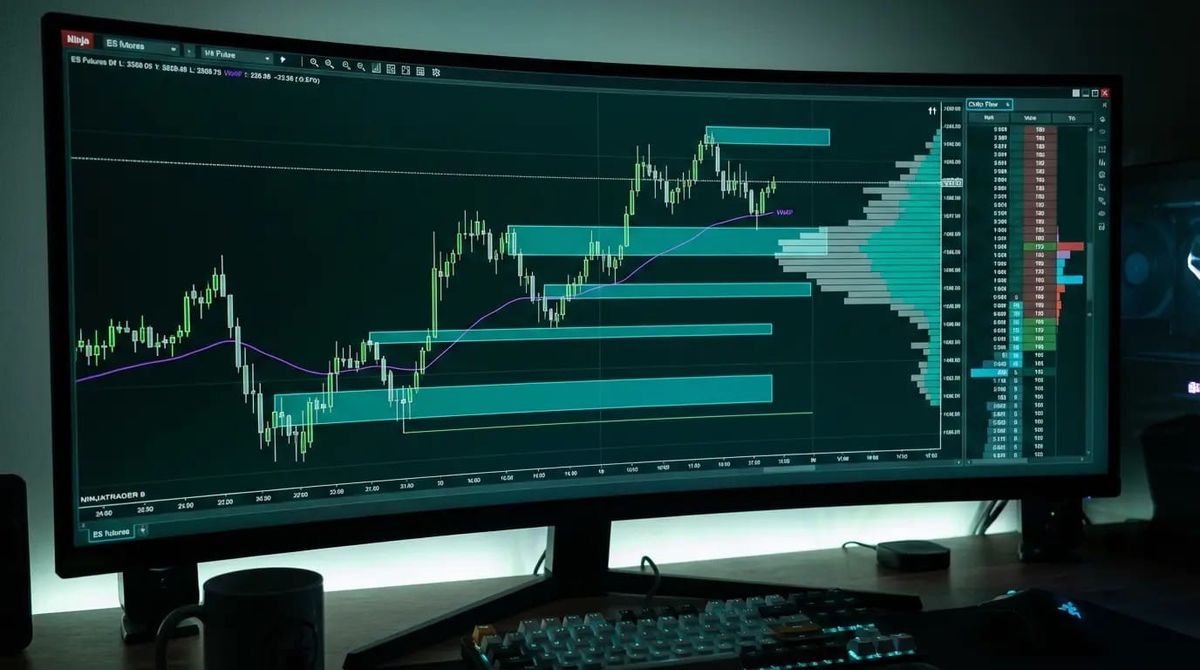
If you're day trading futures on NinjaTrader in 2026, you've probably wondered: should I use indicators to find trades manually, or let an automated strategy handle everything?
It's a fair question. The indicator market is massive — platforms like LuxAlgo have over a million followers on TradingView alone. But there's a growing shift toward fully automated strategies that don't just show you signals — they execute trades without you touching the keyboard.
In this guide, we'll break down the three main approaches to futures day trading: manual trading, indicator-based trading (using LuxAlgo as our example), and fully automated strategies like StealthScalp. By the end, you'll know which approach fits your trading style, schedule, and goals.
The Three Approaches to Day Trading Futures
1. Manual Trading (Chart Reading + Discretion)
Manual trading means you're doing everything yourself — reading price action, identifying setups, placing orders, managing risk, and closing positions. No tools beyond your charting platform.
Who it's for: Experienced traders who've spent years studying market structure, order flow, and price action. Think ICT concepts, supply and demand zones, volume profile analysis. The reality: Most retail traders who go fully manual struggle. Studies consistently show that 70-90% of retail day traders lose money, and a big chunk of that comes from emotional decision-making. You can have the best analysis in the world, but if you hesitate on entries, move your stop loss, or revenge trade after a loss — none of it matters. Time commitment: You need to be glued to your charts during your trading session. Miss a 30-second window? The trade is gone.
2. Indicator-Based Trading (Signals + Manual Execution)
This is where most traders land. You subscribe to an indicator service that overlays buy/sell signals on your charts. You still execute trades manually, but the indicators tell you when to trade.
The most popular option in this space? LuxAlgo.
3. Fully Automated Strategies (Set It and Forget It)
Automated strategies take the human element out entirely. The algorithm identifies setups, places orders, manages stops, and closes positions — all without your input. You configure it once, enable it, and let it run.
This is where NinjaTrader really shines compared to TradingView. NinjaTrader 8 was built for automation — it connects directly to your broker and can execute trades in real-time with zero latency.
LuxAlgo Review: The Most Popular Trading Indicator in 2026
LuxAlgo has earned its reputation. With 1.1 million followers on TradingView and the highest-rated paid indicator on the platform (30,000+ likes on their Signals & Overlays toolkit), they're the gold standard for indicator-based trading.
What LuxAlgo Offers
- Signals & Overlays Toolkit: Buy/sell signals based on price patterns and market structure. Their flagship product.
- Oscillator Matrix: Momentum and trend analysis with multiple confirmation layers.
- Price Action Concepts Toolkit: ICT-inspired tools including fair value gaps, order blocks, and liquidity levels.
- AI Backtesting: Backtest millions of strategy combinations using their AI engine.
- Screeners: Real-time market scanners for spotting setups across multiple instruments.
LuxAlgo Pricing (2026)
| Plan | Price | What You Get |
|---|---|---|
| Essential | $39.99/mo | One toolkit of your choice |
| Premium | $59.99/mo | All toolkits + screeners + AI backtesting |
They also offer annual plans at a discount. Not cheap, but competitive for what you get.
Where LuxAlgo Falls Short
Here's the thing about LuxAlgo — and every indicator service, for that matter:
You still have to execute the trades yourself.
LuxAlgo runs on TradingView. TradingView is a charting platform, not a broker. When LuxAlgo flashes a buy signal, you need to:
- See the signal in real-time (hope you weren't in the bathroom)
- Switch to your broker or trading platform
- Calculate your position size
- Place the order at the right price
- Set your stop loss and take profit
- Monitor the trade
- Close it when the signal says to
That entire process takes anywhere from 10-30 seconds if you're fast. In futures trading, 10 seconds can mean the difference between a winning trade and a losing one.
And the biggest issue? Your emotions are still in the equation. You might see a buy signal and think, "Eh, this doesn't look right," and skip it. Then watch it run for 20 ticks without you. Or you take a signal, it goes against you briefly, and you panic-close before it reverses into profit.
LuxAlgo gives you better information to make decisions. But you're still the one making decisions — and that's where most traders fail.
Best Technical Indicators for Day Trading on NinjaTrader
If you're committed to the indicator route on NinjaTrader specifically, here are the most effective built-in and third-party indicators:
Built-In NinjaTrader Indicators
- Volume Profile: Shows price levels with the most trading activity. Essential for identifying support/resistance.
- VWAP (Volume Weighted Average Price): The institutional benchmark. Most prop firm traders use this as their primary reference.
- Order Flow+ (Footprint Charts): Shows buying and selling pressure at each price level. NinjaTrader's edge over TradingView.
- ATR (Average True Range): Critical for position sizing and stop loss placement.
- EMA Crosses (9/21 or 20/50): Simple but effective trend identification.
Third-Party NinjaTrader Indicators
- Orderflow Labs: Professional-grade order flow tools.
- Rancho Dinero: Delta-based indicators for footprint analysis.
- WyckoffVolume: Volume spread analysis tools.
These are all solid tools. But they all share the same limitation as LuxAlgo: they show you what to do, not do it for you.
The Case for Fully Automated Trading
Here's where the conversation gets interesting.
What if instead of spending $40-60/month on indicators that still require you to manually execute every trade, you could deploy a strategy that handles everything automatically?
That's exactly what StealthScalp was built to do.
StealthScalp: Fully Automated NinjaTrader 8 Strategy
StealthScalp is a fully automated trading strategy built natively for NinjaTrader 8. It doesn't give you signals — it trades for you.
How it works:
- ICT-Inspired FVG Logic: Uses Fair Value Gap (FVG) concepts to identify high-probability entries — the same institutional logic that manual ICT traders spend years trying to master.
- One Trade Per Day: Disciplined approach. No overtrading, no revenge trades, no "just one more."
- EOD Flatten: Every position is closed by end of day. No overnight risk. No gap risk.
- Fixed Risk-to-Reward: Predetermined targets and stops. No second-guessing, no moving your stop loss because you're scared.
What makes it different from indicators:
| Feature | Indicators (LuxAlgo) | Automated (StealthScalp) |
|---|---|---|
| Identifies setups | ✅ | ✅ |
| Executes trades | ❌ (you do it) | ✅ (automatic) |
| Manages risk | ❌ (you do it) | ✅ (automatic) |
| Removes emotion | ❌ | ✅ |
| Works while you sleep/work | ❌ | ✅ |
| Requires screen time | Hours per day | Minutes per day |
| Platform | TradingView | NinjaTrader 8 |
| Broker connectivity | None (chart only) | Direct (Tradovate, Rithmic, CQG) |
Compatibility
StealthScalp works with virtually any futures prop firm or live account:
- Prop firms: Apex Trader Funding, TopStep, MyFundedFutures, and any firm that supports NinjaTrader
- Broker connections: Tradovate, Rithmic, CQG
- Markets: Futures (ES, NQ, MES, MNQ, and more)
Pricing
$98/month with a 30-day money-back guarantee.
That's roughly $38 more per month than LuxAlgo's Premium plan — but you're getting actual trade execution, not just signals you have to act on yourself. When you factor in the time saved (no more sitting at charts for hours) and the emotional mistakes eliminated, the ROI math gets very clear very fast.
Indicators vs Automation: Which Should You Choose?
Choose indicators if:
- You genuinely enjoy the process of chart reading and manual execution
- You have 4+ hours per day to dedicate to active trading
- You're building screen time experience for a future career in trading
- You want to understand why trades work at a fundamental level
- You have the emotional discipline to follow signals without deviation
Choose automation if:
- You have a full-time job, business, or other commitments
- You've tried manual trading and keep making emotional mistakes
- You want consistent execution without human error
- You're trading prop firm evaluations and need mechanical consistency
- You want to deploy capital across multiple accounts simultaneously
- You value your time and want trading to be passive income, not a second job
The honest truth:
Most traders think they want indicators. What they actually want is profitable trades with minimal effort. Indicators get you halfway there — they tell you what to trade. But the execution gap between "signal fired" and "trade captured" is where most traders lose money.
Automation closes that gap entirely.
Getting Started
If you're leaning toward the indicator route, LuxAlgo is a solid choice. Start with their Essential plan at $39.99/month and see if you can consistently execute on their signals for 30 days. Track every signal — the ones you took, the ones you skipped, and the ones you took but managed poorly. Be honest with yourself about the results.
If you want to skip the learning curve and deploy a proven automated strategy on NinjaTrader, StealthScalp comes with a 30-day money-back guarantee. Set it up in minutes, let it run on your prop firm evaluation or live account, and let the numbers speak for themselves.
Either way — the worst thing you can do is keep staring at charts with no edge. Pick an approach, commit to it for 30 days, and measure the results.
Your trading account will thank you.